
Triethylenetetramine CAS Number: 112-24-3
| Product | Triethylenetetramine |
| CAS | 112-24-3 |
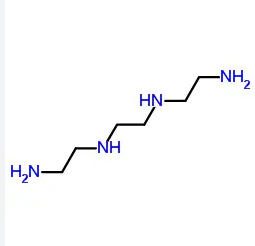
| MF | C6H18N4 |
| Formula | N,N’-DI(2-AMINOETHYL)ETHYLENEDIAMINE;N,N’-BIS(2-AMINOETHYL)ETHYLENEDIAMINE;Ethylenediamine,N,N’-bis(2-aminoethyl)-;hy951;n,n’-bis(2-aminoethyChemicalbookl)-2-ethanediamine;
N,N’-bis-(2-amino-ethyl)-ethane-1,2-diamine;n,n’-bis(2-aminoethyl)-ethylenediamin;N,N’-Bis(2-aminoethyl)-1,2-diaminoethane |
product description
Basic Info.
Triethylenetetramine Properties
| Melting point | 12 °C(lit.) |
|---|---|
| Boiling point | 266-267 °C(lit.) |
| Density | 0.982 g/mL at 25 °C(lit.) |
| vapor density | ~5 (vs air) |
| vapor pressure | <0.01 mm Hg ( 20 °C) |
| refractive index | n20/D 1.496(lit.) |
| Flash point | 290 °F |
| storage temp. | Store below +30°C. |
| solubility | alcohol: soluble |
| pka | pK1:3.32(+4);pK2:6.67(+3);pK3:9.20(+2);pK4:9.92(+1) (20°C) |
| form | Slightly viscous yellow liquid; commercially available form is 95–98% pure, and impurities include linear, branched, and cyclic isomers. |
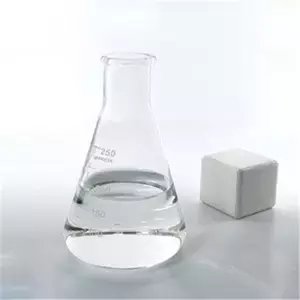
| color | Yellowish liquid or oil |
| PH | 10-11 (10g/l, H2O, 20℃) |
| explosive limit | 0.7-7.2%(V) |
| Water Solubility | SOLUBLE |
| FreezingPoint | 12℃ |
| Sensitive | Moisture Sensitive |
| Merck | 14,9663 |
| BRN | 605448 |
| Exposure limits | ACGIH: TWA 1 ppm (Skin) NIOSH: TWA 1 ppm(4 mg/m3) |
| Stability | Incompatible with strong oxidizing agents, strong acids. |
| InChI | 1S/C6H18N4/c7-1-3-9-5-6-10-4-2-8/h9-10H,1-8H2 |
| InChIKey | VILCJCGEZXAXTO-UHFFFAOYSA-N |
| SMILES | NCCNCCNCCN |
| LogP | -2.65 at 20℃ |
| Indirect Additives used in Food Contact Substances | TRIETHYLENETETRAMINE |
| FDA 21 CFR | 175.105; 175.300; 176.170; 176.180; 177.2600 |
| CAS DataBase Reference | 112-24-3(CAS DataBase Reference) |
| EWG’s Food Scores | 5 |
| FDA UNII | SJ76Y07H5F |
| ATC code | A16AX12 |
| NIST Chemistry Reference | Triethylenetetramine(112-24-3) |
| EPA Substance Registry System | Triethylenetetramine (112-24-3) |
| UNSPSC Code | 12352116 |
| NACRES | NA.22 |
SAFETY
Risk and Safety Statements
| Symbol(GHS) |   GHS05,GHS07 |
|---|---|
| Signal word | Danger |
| Hazard statements | H312-H314-H317-H412 |
| Precautionary statements | P261-P272-P273-P280-P303+P361+P353-P305+P351+P338 |
| PPE | Faceshields, Gloves, Goggles, type ABEK (EN14387) respirator filter |
| Hazard Codes | C |
| Risk Statements | 21-34-43-52/53 |
| Safety Statements | 26-36/37/39-45-61 |
| RIDADR | UN 2259 8/PG 2 |
| WGK Germany | 2 |
| RTECS | YE6650000 |
| Autoignition Temperature | 335 °C |
| TSCA | TSCA listed |
| HazardClass | 8 |
| PackingGroup | II |
| HS Code | 29212900 |
| Storage Class | 8A – Combustible corrosive hazardous materials |
| Hazard Classifications | Acute Tox. 4 Dermal Aquatic Chronic 2 Eye Dam. 1 Skin Corr. 1B Skin Sens. 1 |
| Hazardous Substances Data | 112-24-3(Hazardous Substances Data) |
| Toxicity | LD50 orally in rats: 2.5 g/kg (Spitz) |
Triethylenetetramine Chemical Properties,Uses,Production
Description
Triethylenetetramine (TETA and trien) also known as trientine (INN) when used medically, is an organic compound with the formula [CH2NHCH2CH2NH2]2. The pure freebase is a colorless oily liquid, but, like many amines, older samples assume a yellowish color due to impurities resulting from air- oxidation. It is soluble in polar solvents. The branched isomer tris(2-aminoethyl)amine and piperazine derivatives may also be present in commercial samples of Triethylenetetramine. The hydrochloride salts are used medically as a treatment for copper toxicity.
Chemical Properties
Triethylenetetramine is a corrosive liquid.
Uses
Triethylenetetramine is used as an amine hardener in epoxy resin of the bisphenol A type.It is used in synthesis of detergents, softeners, and dyestuffs; manufacture of pharmaceuticals; vulcanization accelerator of rubber; thermo setting resin; epoxy curing agent; lubricating-oil additive; analytical reagent for Cu, Ni; chelating agent; treatment of Wilson’s disease.
Production Methods
Triethylenetetramine(TETA) is manufactured by reacting ethylene dichloride and ammonia under controlled conditions.
Definition
ChEBI: 2,2,2-tetramine is a polyazaalkane that is decane in which the carbon atoms at positions 1, 4, 7 and 10 are replaced by nitrogens. It has a role as a copper chelator. It is a tetramine and a polyazaalkane.
brand name
Syprine (Merck).
General Description
A yellowish liquid. Less dense than water. Combustible, though may be difficult to ignite. Corrosive to metals and tissue. Vapors heavier than air. Toxic oxides of nitrogen produced during combustion. Used in detergents and in the synthesis of dyes, pharmaceuticals and other chemicals.
Chemical Properties
Triethylenetetramine (TETA) is hygroscopic, corrosive, and has a strong ammoniacal odor. With water a crystalline hydrate is formed. Like DETA, it is completely miscible with water and many polar organic solvents, but less so with lipids; with CCl4 a violent reaction occurs. Its four pKa values are 3.32, 6.67, 9.20, and 9.92. Technical-grade TETA is sometimes available as a distillation cut that also contains branched isomers and cyclic compounds.
Reactivity Profile
Triethylenetetramine is a strong base; reacts violently with strong oxidants; attacks aluminum, zinc, copper and its alloys. Handling Chemicals Safely 198. p. 934).
Health Hazard
Vapors from hot liquid can irritate eyes and upper respiratory system. Liquid burns eyes and skin. May cause sensitization of skin.
Fire Hazard
Combustible material: may burn but does not ignite readily. When heated, vapors may form explosive mixtures with air: indoors, outdoors and sewers explosion hazards. Contact with metals may evolve flammable hydrogen gas. Containers may explode when heated. Runoff may pollute waterways. Substance may be transported in a molten form.
Flammability and Explosibility
Non flammable
Contact allergens
Triethylenetetramine is used as an amine hardener in epoxy resins of the bisphenol A type. Cross-sensitivity is possible with diethylenetriamine and diethylenediamine.
Toxicology
Triethylenetetramine may induce lung edema on inhalation of its vapors. The compound is also an effective skin sensitizer. Following repeated dosing (ca. 50 mg each, 17 – 55 times) onto the skin of pregnant and nonpregnant guinea pigs, significant amounts were absorbed by the strongly irritated skin, leading to toxic effects in the kidneys, liver, brain, and placenta and causing abortion. Triethylenetetramine proved to be a mutagen in vitro but not in vivo.
Safety Profile
Poison by intravenous route. Moderately toxic by ingestion and skin contact. An experimental teratogen. Experimental reproductive effects. Mutation data reported. A corrosive irritant to skin, eyes, and mucous membranes. Causes skin sensitization. Combustible when exposed to heat or flame. Ignites on contact with cellulose nitrate of high surface area. Can react with oxidizing materials. To fight fire, use CO2, dry chemical, alcohol foam. When heated to decomposition it emits toxic fumes of NOx.
Carcinogenicity
TETA was mutagenic in bacterial assays and was positive in sister chromatid exchanges and unscheduled DNA synthesis tests in vitro.8 It was not clastogenic in the mouse micronucleus test in vivo after oral or intraperitoneal administration.
Purification Methods
Dry the amine with sodium, then distil it under a vacuum. Further purification has been via the nitrate or the chloride salts. For example, Jonassen and Strickland [J Am Chem Soc 80 312 1958] separated TRIEN from admixture with TREN (38%) by solution in EtOH, cooling to approximately 5o in an ice-bath and adding conc HCl dropwise from a burette, keeping the temperature below 10o, until all of the white crystalline precipitate of TREN.HCl (see p 191) had formed and was removed. Further addition of HCl then precipitated thick, creamy white TRIEN.HCl (see below) which was crystallised several times from hot water by adding an excess of cold EtOH. The crystals were finally washed with Me2CO, then Et2O and dried in a vacuum desiccator. [Beilstein 4 H 255, 4 II 695, 4 III 542, 4 IV 1242.]
Toxics Screening Level
The initial threshold screening level (ITSL) for triethylene tetramine (TETA) is 8 μg/m 3 based on annual averaging time.
Triethylenetetramine Preparation Products And Raw materials
FAQ
Q1: About the after-sale service of products
A: After purchasing the products from our factory, we have A professional technical team and after-sales team to serve you and solve all your problems in the future.
Q2: Can I get some samples?
A: Yes, we can provide samples, but the customer will pay the freight.
Q3: How do I start paying?
Payment can be made by wire transfer or T/T, apple_pay, google_pay, gc_real_time_bank_transfer , etc.
Q4: How to confirm product quality before placing an order?
A: You can get free samples of some products. You just have to pay the shipping fee or arrange for the sample to be sent to us by express.
You can send us your product specifications and requirements and we will produce products according to your requirements.
Q5: What is your MOQ?
A: The minimum quantity we can order is 1kg.
But usually we can accept a smaller quantity, say 100g, at the cost of 100% sample charge.
Q6: Shipping Time?
A: We ship the parcel out in 1-2 days and offer tracking No.. Shipping time is different to different country. Please consult
| ACF Chemical Co., Ltd.
Leon phone/whatsapp:008615950692266 email:md@acfchemical.com No. 45 Pengwan Road, Qianwan Bonded Port Area, Qingdao Area, China (Shandong) |
|
| DMEA | 108-01-0 |
| Dodecyl trimethyl ammonium chloride | 112-00-5 |
| N-Hexadecyltrimethylammonium chloride | 112-02-7 |
| 1831 | 112-03-8 |
| 1631Br | 57-09-0 |
| D821 | 5538-94-3 |
| D8/1021 | 68424-95-3 |
| D1021 | 7173-51-5 |
| D1821 | 61789-80-8 |
| TEP88 | 157905-74-3 |
| 1227 C12 | 139-07-1 |
| DMPT(N,N-Dimethyl-p-toluidine) | 99-97-8 |
| NDPT(N,N-dihydroxyethyl-p-toluidine) | 3077-12-1. |
| DMA(N,N-dimethylaniline) | 121-69-7 |
| N,N-Diethylaniline | 91-66-7 |
| MT(M-Toluidine) | 108-44-1 |
| PT(P-Toluidine) | 106-49-0 |
| O-Toluidine OT | 95-53-4 |
| Dimethyl(octyl)amine | 7378-99-6/1120-24-7 |
| C16-18-alkyldimethyl Octadecyl/Hexadecyl dimethylamines | 68390-97-6 |
| Octadecyl/behenyl dimethylamines | 124046-42-0 |
| N,N-dimethyldocosylamine | 21542-96-1 |
| N-Methyldioctylamine | 4455-26-9 |
| Di(octyl/decyl) methylamines | 308062-61-5 |
| Didecyl methylamine | 7396-58-9 |
| N-methyldidodecylamine | 2915-90-4 |
| Dipalmitamine | 16724-61-1 |
| Trioctylamine | 1116-76-3 |
| Trioctylamine | 68814-95-9 |
| N-3-Laurylamidopropyl dimethylamine | 3179-80-4 |
| N-3-(Hydrogenated cocoamido)propyl dimethylamines | 288095-05-6 |
| N-3-Oleylamidopropyl dimethylamine | 109-28-4 |
| N-3-Erucylamidopropyl dimethylamine | 60270-33-9 |
| N-Oleyl 1,3-propanediamine | 7173-62-8 |
| Bis(aminopropyl)laurylamine | 2372-82-9 |
| N-tallow alkyltripropylenetetra | 68911-79-5 |
| 3-(isodecyloxy)propylamine | 30113-45-2 |
| N-[3-(isodecyloxy)propyl]propane-1,3-diamine | 72162-46-0 |
| 2-(Methylamino)ethanol | 109-83-1 |
| N-Methyldiethanolamine | 105-59-9 |
| 3-Methoxy propyl amine | 5332-73-0 |
| N,N-dimethylcyclohexylamine | 98-94-2 |
| 1,3,5-Tris[3-(dimethylamino)propyl]hexahydro-1,3,5-triazine | 15875-13-5 |
| N,N,N’-trimethylamino-N’-ethylethanolamine | 2212-32-0 |
| N,N-Dimethylethanolamine | 108-01-1 |
| Acetone | |
| Acrylic acid | |
| Adipic acid | |
| Alpha-Methylstyrene (AMS) | |
| Benzoic Acid | |
| Bisphenol A | |
| Butyl Acrylat (BA) | |
| Butyl acetate (Butac) | |
| Butyl diglycol (BDG) | |
| Butyl glycol | |
| Para-tertiary butyl benzoic acid (PTBBA) | |
| n-Butanol | |
| n-Butyl methacrylate (n-BUMA) | |
| para-tert. Butylphenol (PTBP) | |


