
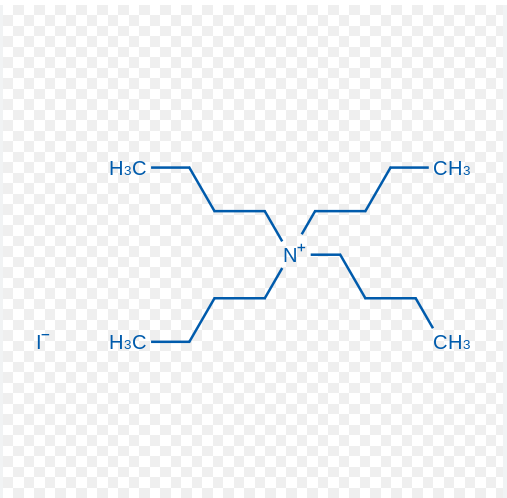
Tetrabutylammonium iodide CAS Number: 311-28-4
| Product | Tetrabutylammonium iodide |
| CAS | 311-28-4 |
| MF | C16H36IN |
| Formula | TETRABUTYLAMMONIUMIODIDEextrapureAR;Tetrabutylazaniumiodide;Tetrabutylammoniumiodide,99%;Tetrabutylaminium·iodide;TeChemicalbooktrabutylammoniumiodide,HPLCgrade;Tetrabutylammoniumiodide,extrapure;
Tetrabutylammoniumi;Tetra(but-1-yl)ammoniumiodide |
product description
Basic Info.
Tetrabutylammonium iodide Properties
| Melting point | 141-143 °C(lit.) |
|---|---|
| Boiling point | 145.3℃[at 101 325 Pa] |
| Density | 1.20 |
| vapor pressure | 0Pa at 25℃ |
| storage temp. | Store below +30°C. |
| solubility | acetonitrile: 0.1 g/mL, clear, colorless |
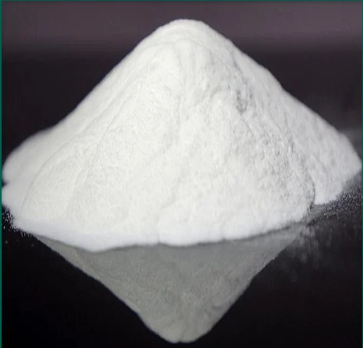
| form | Crystalline Powder |
| color | White to cream |
| Appearance | White to almost white powder, crystals, or flakes. |
| Odor | Amine like |
| Water Solubility | Soluble in water and methanol. Insoluble in benzene. |
| λmax | λ: 290 nm Amax: 0.1 λ: 300 nm Amax: 0.05 λ: 320 nm Amax: 0.02 λ: 500 nm Amax: 0.02 |
| Sensitive | Light Sensitive & Hygroscopic |
| BRN | 3916152 |
| Exposure limits | ACGIH: TWA 0.01 ppm |
| Stability | Stable. Incompatible with strong oxidizing agents. Light-sensitive. |
| InChI | 1S/C16H36N.HI/c1-5-9-13-17(14-10-6-2,15-11-7-3)16-12-8-4;/h5-16H2,1-4H3;1H/q+1;/p-1 |
| InChIKey | DPKBAXPHAYBPRL-UHFFFAOYSA-M |
| SMILES | [I-].CCCC[N+](CCCC)(CCCC)CCCC |
| LogP | 0.869 at 25℃ |
| CAS DataBase Reference | 311-28-4(CAS DataBase Reference) |
| EPA Substance Registry System | Tetrabutylammonium iodide (311-28-4) |
| UNSPSC Code | 12352107 |
| NACRES | NB.21 |
SAFETY
Risk and Safety Statements
| Symbol(GHS) |  GHS07 |
|---|---|
| Signal word | Warning |
| Hazard statements | H302 |
| Precautionary statements | P264-P270-P301+P312+P330-P501 |
| PPE | dust mask type N95 (US), Eyeshields, Gloves |
| Hazard Codes | Xn |
| Risk Statements | 22-36/37/38 |
| Safety Statements | 26-36-37/39 |
| WGK Germany | 3 |
| RTECS | BS5450000 |
| F | 8 |
| TSCA | TSCA listed |
| HS Code | 29239000 |
| Storage Class | 11 – Combustible Solids |
| Hazard Classifications | Acute Tox. 4 Oral Eye Irrit. 2 Skin Irrit. 2 |
| Toxicity | LD50 orally in Rabbit: 1990 mg/kg |
Tetrabutylammonium iodide Chemical Properties,Uses,Production
Description
Tetrabutylammonium iodide is a organic ammonium compound, for which all four valences of a nitrogen atom are bonded organically. It is often used as phase-transfer catalysts and ion pair reagents.
Chemical Properties
Tetrabutylammonium iodide is an organic ammonium compound with the molecular formula C16H36IN. white or tan powder. Soluble in water and ethanol, slightly soluble in chloroform and benzene. Stable under normal temperature and pressure.
Uses
Tetrabutylammonium iodide is used in the preparation of novel quaternary amines to serve as antibacterial agents in the rise of drug-resistant bacteria,it is also used in phosphonium reversible inhibitors of cholinesterases.
Application
Tetrabutylammonium iodide may be used as a mobile phase additive in ion-pair high-performance liquid chromatography (IP-HPLC) assay of 4-aminopyridine in serum. It may also be used as a mobile phase additive in the analysis of tetracycline by reversed-phase IPC. The addition of tetrabutylammonium iodide regulates the retention of tetracyclines.
Tetrabutylammonium iodide can be used:
As an additive in the synthesis of fused triazole derivatives using palladium catalyst.
To prepare allyl-PEG-allyl, which is a key intermediate polymer used to synthesize fluorinated amphiphilic copolymers.
As a catalyst used in the synthesis of ethers.
Reactions
Tetrabutylammonium iodide (TBAI) has been used as a catalyst in the following reactions:
Synthesis of O-benzyl-N-Boc-L-tyrosine benzyl ester from N-Boc-L-tyrosine.
Conversion of 8-fluoro-1-aminonaphthalene into 1-(8-fluoro-naphthalen-1-yl)piperazine hydrochloride.
Synthesis of 1-(2,4-dichlorophenyl)-5-(4-(4-iodobut-1-ynyl)phenyl)-4-methyl-N-(piperidin-1-yl)-1H-pyrazole-3-carboxamide from 4-(4-(1-(2,4-dichlorophenyl)-4-methyl-3-(piperidin-1-ylcarbamoyl)-1H-pyrazol-5-yl)phenyl)but-3-yn-1-yl methanesulfonate.
Other reactions where TBAI can be used as a catalyst:
TBAI-tert-butyl hydroperoxide system can catalyze the conversion of α-methyl styrene derivatives into allylic sulfones by reacting with sulfonylhydrazides under metal-free conditions.
Palladium(0)-catalyzed cross-coupling between benzylic zinc bromides and aryl or alkenyl triflates.
Three-component coupling of amines, carbon dioxide, and halides to form carbamates in the presence of cesium carbonate.
General Description
Tetrabutylammonium iodide is a quaternary ammonium salt used in phase-transfer reactions. It is also used in regioselective ether cleavage reactions and as a source of iodide for nucleophilic displacement reactions.
Flammability and Explosibility
Not classified
Purification Methods
Crystallise the iodide from toluene/pet ether (see entry for the corresponding bromide), acetone, ethyl acetate, EtOH/diethyl ether, nitromethane, aqueous EtOH or water. Dry it at room temperature under a vacuum. It has also been dissolved in MeOH/acetone (1:3, 10mL/g), filtered and allowed to stand at room temperature to evaporate to ca half its original volume. Distilled water (1mL/g) is then added, and the precipitate is filtered off and dried. It can also be dissolved in acetone, precipitated by adding ether and dried in a vacuum at 90o for 2 days. It has also been recrystallised from CH2Cl2/pet ether or hexane, or anhydrous methanol and stored in a vacuum desiccator over H2SO4. [Chau & Espenson J Am Chem Soc 108 1962 1986, Beilstein 4 IV 558.]
Tetrabutylammonium iodide Preparation Products And Raw materials
FAQ
Q1: About the after-sale service of products
A: After purchasing the products from our factory, we have A professional technical team and after-sales team to serve you and solve all your problems in the future.
Q2: Can I get some samples?
A: Yes, we can provide samples, but the customer will pay the freight.
Q3: How do I start paying?
Payment can be made by wire transfer or T/T, apple_pay, google_pay, gc_real_time_bank_transfer , etc.
Q4: How to confirm product quality before placing an order?
A: You can get free samples of some products. You just have to pay the shipping fee or arrange for the sample to be sent to us by express.
You can send us your product specifications and requirements and we will produce products according to your requirements.
Q5: What is your MOQ?
A: The minimum quantity we can order is 1kg.
But usually we can accept a smaller quantity, say 100g, at the cost of 100% sample charge.
Q6: Shipping Time?
A: We ship the parcel out in 1-2 days and offer tracking No.. Shipping time is different to different country. Please consult
| ACF Chemical Co., Ltd.
Leon phone/whatsapp:008615950692266 email:md@acfchemical.com No. 45 Pengwan Road, Qianwan Bonded Port Area, Qingdao Area, China (Shandong) |
|
| DMEA | 108-01-0 |
| Dodecyl trimethyl ammonium chloride | 112-00-5 |
| N-Hexadecyltrimethylammonium chloride | 112-02-7 |
| 1831 | 112-03-8 |
| 1631Br | 57-09-0 |
| D821 | 5538-94-3 |
| D8/1021 | 68424-95-3 |
| D1021 | 7173-51-5 |
| D1821 | 61789-80-8 |
| TEP88 | 157905-74-3 |
| 1227 C12 | 139-07-1 |
| DMPT(N,N-Dimethyl-p-toluidine) | 99-97-8 |
| NDPT(N,N-dihydroxyethyl-p-toluidine) | 3077-12-1. |
| DMA(N,N-dimethylaniline) | 121-69-7 |
| N,N-Diethylaniline | 91-66-7 |
| MT(M-Toluidine) | 108-44-1 |
| PT(P-Toluidine) | 106-49-0 |
| O-Toluidine OT | 95-53-4 |
| Dimethyl(octyl)amine | 7378-99-6/1120-24-7 |
| C16-18-alkyldimethyl Octadecyl/Hexadecyl dimethylamines | 68390-97-6 |
| Octadecyl/behenyl dimethylamines | 124046-42-0 |
| N,N-dimethyldocosylamine | 21542-96-1 |
| N-Methyldioctylamine | 4455-26-9 |
| Di(octyl/decyl) methylamines | 308062-61-5 |
| Didecyl methylamine | 7396-58-9 |
| N-methyldidodecylamine | 2915-90-4 |
| Dipalmitamine | 16724-61-1 |
| Trioctylamine | 1116-76-3 |
| Trioctylamine | 68814-95-9 |
| N-3-Laurylamidopropyl dimethylamine | 3179-80-4 |
| N-3-(Hydrogenated cocoamido)propyl dimethylamines | 288095-05-6 |
| N-3-Oleylamidopropyl dimethylamine | 109-28-4 |
| N-3-Erucylamidopropyl dimethylamine | 60270-33-9 |
| N-Oleyl 1,3-propanediamine | 7173-62-8 |
| Bis(aminopropyl)laurylamine | 2372-82-9 |
| N-tallow alkyltripropylenetetra | 68911-79-5 |
| 3-(isodecyloxy)propylamine | 30113-45-2 |
| N-[3-(isodecyloxy)propyl]propane-1,3-diamine | 72162-46-0 |
| 2-(Methylamino)ethanol | 109-83-1 |
| N-Methyldiethanolamine | 105-59-9 |
| 3-Methoxy propyl amine | 5332-73-0 |
| N,N-dimethylcyclohexylamine | 98-94-2 |
| 1,3,5-Tris[3-(dimethylamino)propyl]hexahydro-1,3,5-triazine | 15875-13-5 |
| N,N,N’-trimethylamino-N’-ethylethanolamine | 2212-32-0 |
| N,N-Dimethylethanolamine | 108-01-1 |
| Acetone | |
| Acrylic acid | |
| Adipic acid | |
| Alpha-Methylstyrene (AMS) | |
| Benzoic Acid | |
| Bisphenol A | |
| Butyl Acrylat (BA) | |
| Butyl acetate (Butac) | |
| Butyl diglycol (BDG) | |
| Butyl glycol | |
| Para-tertiary butyl benzoic acid (PTBBA) | |
| n-Butanol | |
| n-Butyl methacrylate (n-BUMA) | |
| para-tert. Butylphenol (PTBP) | |


