
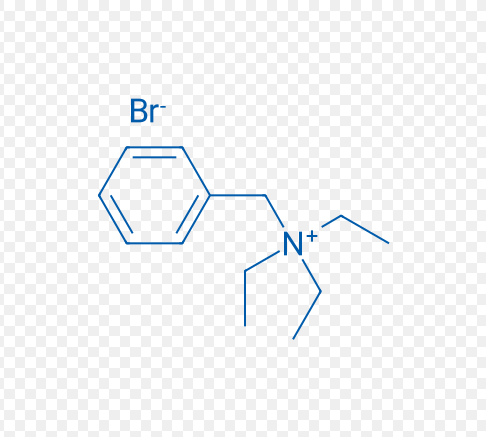

Benzyltriethylammonium bromide CAS Number: 5197-95-5
| Product | Benzyltriethylammonium bromide |
| CAS | 5197-95-5 |
| MF | C13H22BrN |
| Formula | Benzyltriethylammoniumbromide99-102%(Assay);Benzyltriethylammoniumbromide99%;[BzE3N]Br;triethyl-(phenylmethyl)ammonChemicalbookiumbromide;BENZYLTRIETHYLAMMONIUMBROMIDE;TRIETHYLBENZYLAMMONIUMBROMIDE;BTEAB;N-Benzyl-N,N,N-triethylammoniumbromide |
product description
Basic Info.
Benzyltriethylammonium bromide Properties
| Melting point | 193-195 °C (dec.) (lit.) |
|---|---|
| Density | 1.2838 (rough estimate) |
| refractive index | 1.5260 (estimate) |
| storage temp. | Sealed in dry,Room Temperature |
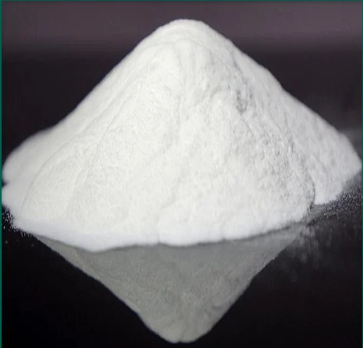
| form | Crystalline Powder |
| color | Off-white |
| Water Solubility | soluble |
| Sensitive | Hygroscopic |
| BRN | 3739113 |
| InChI | 1S/C13H22N.BrH/c1-4-14(5-2,6-3)12-13-10-8-7-9-11-13;/h7-11H,4-6,12H2,1-3H3;1H/q+1;/p-1 |
| InChIKey | CHQVQXZFZHACQQ-UHFFFAOYSA-M |
| SMILES | [Br-].CC[N+](CC)(CC)Cc1ccccc1 |
| CAS DataBase Reference | 5197-95-5(CAS DataBase Reference) |
| UNSPSC Code | 12352116 |
| NACRES | NA.22 |
SAFETY
Risk and Safety Statements
| Symbol(GHS) |  GHS07 |
|---|---|
| Signal word | Warning |
| Hazard statements | H315-H319-H335 |
| Precautionary statements | P261-P264-P271-P280-P302+P352-P305+P351+P338 |
| target organs | Respiratory system |
| PPE | dust mask type N95 (US), Eyeshields, Gloves |
| Hazard Codes | Xi |
| Risk Statements | 36/38-36/37/38 |
| Safety Statements | 26-36-37/39 |
| RIDADR | UN 2811 |
| WGK Germany | 3 |
| F | 3-10 |
| HS Code | 29239000 |
| Storage Class | 11 – Combustible Solids |
| Hazard Classifications | Eye Irrit. 2 Skin Irrit. 2 STOT SE 3 |
Benzyltriethylammonium bromide Chemical Properties,Uses,Production
Description
Benzyltriethylammonium bromide is a versatile quaternary ammonium salt widely utilized in various chemical and industrial applications.
Chemical Properties
white to light yellow crystal powde
Uses
Benzyltriethylammonium bromide is recognized for its effectiveness as a phase transfer catalyst, facilitating the transfer of ions between immiscible phases, which enhances reaction rates in organic synthesis. Its ability to solubilize organic compounds in aqueous solutions makes it invaluable in the synthesis of pharmaceuticals, agrochemicals, and fine chemicals. Researchers often leverage its properties in the preparation of quaternary ammonium compounds, surfactants, and as a reagent in organic reactions, such as alkylation and acylation processes.
Application
Benzyltriethylammonium bromide has been used in various applications, including:
Phase transfer catalysis: The compound has been employed as a phase transfer catalyst in organic synthesis reactions, facilitating the transfer of reactants between aqueous and organic phases.
Biomedical research: Benzyltriethylammonium bromide has been used as a selective inhibitor of certain enzymes, such as protein kinase C.
Pharmaceutical applications: The compound has been investigated as a potential excipient in pharmaceutical formulations, due to its ability to enhance the solubility and stability of certain drugs.
Synthesis
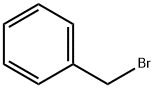
100-39-0
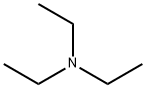
121-44-8
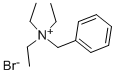
5197-95-5
GENERAL METHOD: Benzyl halide (1 eq.) was dissolved in THF (50 mL/g benzyl halide) with reference to the method described in Ref. 4, to which 1.5 eq. of triethylamine (33 wt% ethanol solution) was subsequently added. The reaction mixture was stirred at room temperature for 24 h. The product precipitated as a white solid during the reaction. The resulting suspension was cooled to 0 °C, filtered, and the filter cake was washed with ice-cold ether and finally dried under vacuum to afford the target product benzyltriethylammonium bromide in a yield consistent with literature reports.
References
[1] Synlett, 2016, vol. 27, # 13, p. 1963 – 1968
[2] Journal of the American Chemical Society, 1980, vol. 102, # 21, p. 6463 – 6465
[3] Journal of Organic Chemistry USSR (English Translation), 1984, vol. 20, p. 1715 – 1723
[4] Zhurnal Organicheskoi Khimii, 1984, vol. 20, # 9, p. 1881 – 1888
[5] Roczniki Chemii, 1965, vol. 39, p. 1223 – 1231
Benzyltriethylammonium bromide Preparation Products And Raw materials
FAQ
Q1: About the after-sale service of products
A: After purchasing the products from our factory, we have A professional technical team and after-sales team to serve you and solve all your problems in the future.
Q2: Can I get some samples?
A: Yes, we can provide samples, but the customer will pay the freight.
Q3: How do I start paying?
Payment can be made by wire transfer or T/T, apple_pay, google_pay, gc_real_time_bank_transfer , etc.
Q4: How to confirm product quality before placing an order?
A: You can get free samples of some products. You just have to pay the shipping fee or arrange for the sample to be sent to us by express.
You can send us your product specifications and requirements and we will produce products according to your requirements.
Q5: What is your MOQ?
A: The minimum quantity we can order is 1kg.
But usually we can accept a smaller quantity, say 100g, at the cost of 100% sample charge.
Q6: Shipping Time?
A: We ship the parcel out in 1-2 days and offer tracking No.. Shipping time is different to different country. Please consult
| ACF Chemical Co., Ltd.
Leon phone/whatsapp:008615950692266 email:md@acfchemical.com No. 45 Pengwan Road, Qianwan Bonded Port Area, Qingdao Area, China (Shandong) |
|
| DMEA | 108-01-0 |
| Dodecyl trimethyl ammonium chloride | 112-00-5 |
| N-Hexadecyltrimethylammonium chloride | 112-02-7 |
| 1831 | 112-03-8 |
| 1631Br | 57-09-0 |
| D821 | 5538-94-3 |
| D8/1021 | 68424-95-3 |
| D1021 | 7173-51-5 |
| D1821 | 61789-80-8 |
| TEP88 | 157905-74-3 |
| 1227 C12 | 139-07-1 |
| DMPT(N,N-Dimethyl-p-toluidine) | 99-97-8 |
| NDPT(N,N-dihydroxyethyl-p-toluidine) | 3077-12-1. |
| DMA(N,N-dimethylaniline) | 121-69-7 |
| N,N-Diethylaniline | 91-66-7 |
| MT(M-Toluidine) | 108-44-1 |
| PT(P-Toluidine) | 106-49-0 |
| O-Toluidine OT | 95-53-4 |
| Dimethyl(octyl)amine | 7378-99-6/1120-24-7 |
| C16-18-alkyldimethyl Octadecyl/Hexadecyl dimethylamines | 68390-97-6 |
| Octadecyl/behenyl dimethylamines | 124046-42-0 |
| N,N-dimethyldocosylamine | 21542-96-1 |
| N-Methyldioctylamine | 4455-26-9 |
| Di(octyl/decyl) methylamines | 308062-61-5 |
| Didecyl methylamine | 7396-58-9 |
| N-methyldidodecylamine | 2915-90-4 |
| Dipalmitamine | 16724-61-1 |
| Trioctylamine | 1116-76-3 |
| Trioctylamine | 68814-95-9 |
| N-3-Laurylamidopropyl dimethylamine | 3179-80-4 |
| N-3-(Hydrogenated cocoamido)propyl dimethylamines | 288095-05-6 |
| N-3-Oleylamidopropyl dimethylamine | 109-28-4 |
| N-3-Erucylamidopropyl dimethylamine | 60270-33-9 |
| N-Oleyl 1,3-propanediamine | 7173-62-8 |
| Bis(aminopropyl)laurylamine | 2372-82-9 |
| N-tallow alkyltripropylenetetra | 68911-79-5 |
| 3-(isodecyloxy)propylamine | 30113-45-2 |
| N-[3-(isodecyloxy)propyl]propane-1,3-diamine | 72162-46-0 |
| 2-(Methylamino)ethanol | 109-83-1 |
| N-Methyldiethanolamine | 105-59-9 |
| 3-Methoxy propyl amine | 5332-73-0 |
| N,N-dimethylcyclohexylamine | 98-94-2 |
| 1,3,5-Tris[3-(dimethylamino)propyl]hexahydro-1,3,5-triazine | 15875-13-5 |
| N,N,N’-trimethylamino-N’-ethylethanolamine | 2212-32-0 |
| N,N-Dimethylethanolamine | 108-01-1 |
| Acetone | |
| Acrylic acid | |
| Adipic acid | |
| Alpha-Methylstyrene (AMS) | |
| Benzoic Acid | |
| Bisphenol A | |
| Butyl Acrylat (BA) | |
| Butyl acetate (Butac) | |
| Butyl diglycol (BDG) | |
| Butyl glycol | |
| Para-tertiary butyl benzoic acid (PTBBA) | |
| n-Butanol | |
| n-Butyl methacrylate (n-BUMA) | |
| para-tert. Butylphenol (PTBP) | |


