
Antioxidant 1076 CAS Number: 2082-79-3
| Product | Antioxidant 1076 |
| CAS | 2082-79-3 |
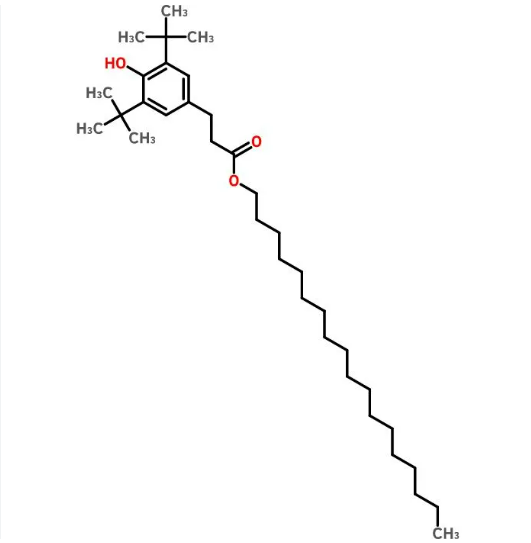
| MF | C35H62O3 |
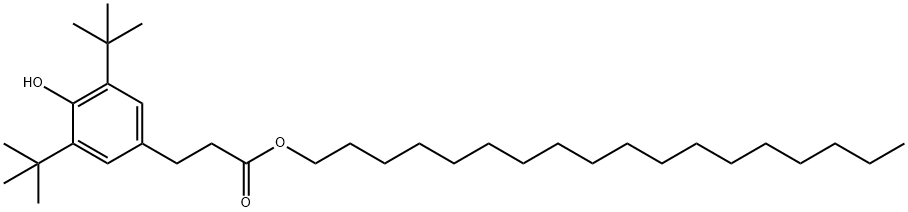
| Formula | IRGANOX1076;3,5-Bis(1,1-dimethylethyl)-4-hydroxybenzenepropanoicacidoctadecylester;RALOX(R)530;N-OCTADECYL3-(3′,5′-DI-T-BUTYL-4′-HYDROXYLPHENYLChemicalbook)PROPIONATE;dibutylhydroxyphenylpropionicacidstearylester;irganox;irganox1906;3-(3′,5′-DI-TERT-BUTYL-4′-HYDROXYPHENYL)PROPIONICACIDSTEARYLESTER |
product description
Basic Info.
Antioxidant 1076 Properties
| Melting point | 50-52 °C(lit.) |
|---|---|
| Boiling point | 568.1±45.0 °C(Predicted) |
| Density | 0.929±0.06 g/cm3(Predicted) |
| Flash point | >230 °F |
| storage temp. | 2-8°C |
| solubility | Chloroform, Ethyl Acetate (Slightly), Methanol (Slightly) |
| pka | 12.33±0.40(Predicted) |
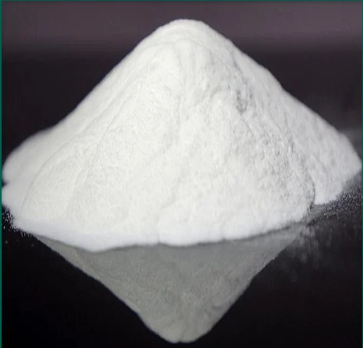
| form | powder |
| color | White to Off-White |
| Water Solubility | 2.85μg/L at 20℃ |
| Stability | Stable. Combustible. Dust/air mixtures are potentially explosive. Incompatible with strong oxidizing agents, strong acids, strong bases. |
| Cosmetics Ingredients Functions | ANTIOXIDANT |
| InChI | 1S/C35H62O3/c1-8-9-10-11-12-13-14-15-16-17-18-19-20-21-22-23-26-38-32(36)25-24-29-27-30(34(2,3)4)33(37)31(28-29)35(5,6)7/h27-28,37H,8-26H2,1-7H3 |
| InChIKey | SSDSCDGVMJFTEQ-UHFFFAOYSA-N |
| SMILES | CCCCCCCCCCCCCCCCCCOC(=O)CCc1cc(c(O)c(c1)C(C)(C)C)C(C)(C)C |
| LogP | 13.930 (est) |
| Indirect Additives used in Food Contact Substances | OCTADECYL 3,5-DI-TERT-BUTYL-4-HYDROXYHYDROCINNAMATE |
| CAS DataBase Reference | 2082-79-3(CAS DataBase Reference) |
| FDA 21 CFR | 175.105; 177.1010 |
| EWG’s Food Scores | 1 |
| FDA UNII | V88J661G2P |
| EPA Substance Registry System | Octadecyl 3,5-bis(tert-butyl)-4-hydroxyhydrocinnamate (2082-79-3) |
| UNSPSC Code | 41116107 |
| NACRES | NA.24 |
SAFETY
Risk and Safety Statements
| Symbol(GHS) |  GHS07 |
|---|---|
| Signal word | Warning |
| Hazard statements | H315-H319 |
| Precautionary statements | P264-P280-P302+P352+P332+P313+P362+P364-P305+P351+P338+P337+P313 |
| PPE | dust mask type N95 (US), Eyeshields, Gloves |
| Hazard Codes | Xi |
| Risk Statements | 36/37/38-36/38 |
| Safety Statements | 26-37/39-36 |
| WGK Germany | – |
| TSCA | TSCA listed |
| HS Code | 29182900 |
| Storage Class | 11 – Combustible Solids |
| Hazardous Substances Data | 2082-79-3(Hazardous Substances Data) |
Antioxidant 1076 Chemical Properties,Uses,Production
Characterization
Antioxidant 1076, a sterically hindered phenolic antioxidant, is highly efficient, non discoloring stabilizer for organic substrates such as plastics, synthetic fibers, elastomers, adhesives, waxes, oils and fats. It protects these substrates against thermo-oxidative degradation. IRGANOX 1076 is odorless, stable to light and has excellent color retention. It has good compatibility with most substrates, low volatility and high resistance to extraction.
Applications
Antioxidant 1076 can be applied in polyolefins such as polyethylene, polypropylene, polybutene-1 as well as in other polymers such as engineering plastics, styrene homo- and copolymers, polyurethanes, elastomers, adhesives, and other organic substrates.
Features/benefits
Antioxidant 1076 can be used in combination with other additives such as costabilizers (e.g. thioesters, phosphites, phosphonites), light stabilizers, and other functional stabilizers.
Physical Properties
Handling & Safety
In accordance with good industrial practice, handle with care and prevent contamination of the environment. Avoid dust formation and ignition sources.
Description
Antioxidant 1076 is odorless, tasteless and less toxicity and stable to light so that it can widely used in polymer materials, such as polypropylene polyethylene, polystyrene, polyamide, polyoxymethylene, ABS, synthetic rubber and so on. It is an effective antioxidant in oil and paint, too. Antioxidant 1076 is a nonpolluting nontoxic Antioxidant with good heat-resisting and water-extracting performance. widely applied to polyolefine, polyamnamee, polyester, polyvinyl chlornamee, ABS resin and petroleum product, often used with DLTP for promoting the antioxnameative effect.
Chemical Properties
white crystalline powder
Uses
1076 is a nonpolluting nontoxic antioxidant with good heat-resisting and water-extracting performance. It can be applied in polyolefins, such as polyeth-ylene, polypropylene, polybutene-1 and other polymers such as engineering plastics ,styrenes, polyurethanes, saturated and unsaturated elastomers, styrenics, rubber modified styrenics, segmented block copolymers, and PVC. Also often used with DLTDP for promoting the antioxidative effect.
Uses
Octadecyl 3-(3,5-di-tert-butyl-4-hydroxyphenyl)propionate is a 4 chain-breaking antioxidant. A study shows that Octadecyl 3-(3,5-di-tert-butyl-4-hydroxyphenyl)propionate can protect the oxidation of soybean phosphatidylcholine liposomes in water dispersion, but cannot protect the oxidation of dimyristoyl phosphatidylcholine liposomes.
Application
Antioxidant 1076 finds application in plastics, rubber, latex, varnishes, adhesives, TPR’s and Hot Melts. In plastics, antioxidant 1076 provides excellent antioxidant performance in Polyethylene, Polystyrene, Polyacetal, PVC, AS resin, Methacrylic resin, Polycarbonate, Polyester, and Polymethyl- pentene as well as many others. In rubbers, Antioxidant 1076 can be used in SBR, EPR, EPDM, Polybutadiene, Neoprene, Nitrile, Polyisoprene, and many other synthetic rubbers. Typical dosage is 0.02% – 0.5% by weight.
General Description
Octadecyl 3-(3,5-di-tert-butyl-4-hydroxyphenyl)propionate is a propionate based phenolic antioxidant that can be used as a polymeric stabilizer by butylphenol functionalities.
Safety
FDA approved for use in indirect food contact applications. This product is of low toxicity to aquatic organisms.

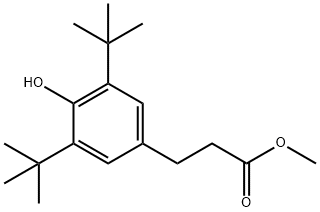
Antioxidant 1076 Preparation Products And Raw materials
FAQ
Q1: About the after-sale service of products
A: After purchasing the products from our factory, we have A professional technical team and after-sales team to serve you and solve all your problems in the future.
Q2: Can I get some samples?
A: Yes, we can provide samples, but the customer will pay the freight.
Q3: How do I start paying?
Payment can be made by wire transfer or T/T, apple_pay, google_pay, gc_real_time_bank_transfer , etc.
Q4: How to confirm product quality before placing an order?
A: You can get free samples of some products. You just have to pay the shipping fee or arrange for the sample to be sent to us by express.
You can send us your product specifications and requirements and we will produce products according to your requirements.
Q5: What is your MOQ?
A: The minimum quantity we can order is 1kg.
But usually we can accept a smaller quantity, say 100g, at the cost of 100% sample charge.
Q6: Shipping Time?
A: We ship the parcel out in 1-2 days and offer tracking No.. Shipping time is different to different country. Please consult
| ACF Chemical Co., Ltd.
Leon phone/whatsapp:008615950692266 email:md@acfchemical.com No. 45 Pengwan Road, Qianwan Bonded Port Area, Qingdao Area, China (Shandong) |
|
| DMEA | 108-01-0 |
| Dodecyl trimethyl ammonium chloride | 112-00-5 |
| N-Hexadecyltrimethylammonium chloride | 112-02-7 |
| 1831 | 112-03-8 |
| 1631Br | 57-09-0 |
| D821 | 5538-94-3 |
| D8/1021 | 68424-95-3 |
| D1021 | 7173-51-5 |
| D1821 | 61789-80-8 |
| TEP88 | 157905-74-3 |
| 1227 C12 | 139-07-1 |
| DMPT(N,N-Dimethyl-p-toluidine) | 99-97-8 |
| NDPT(N,N-dihydroxyethyl-p-toluidine) | 3077-12-1. |
| DMA(N,N-dimethylaniline) | 121-69-7 |
| N,N-Diethylaniline | 91-66-7 |
| MT(M-Toluidine) | 108-44-1 |
| PT(P-Toluidine) | 106-49-0 |
| O-Toluidine OT | 95-53-4 |
| Dimethyl(octyl)amine | 7378-99-6/1120-24-7 |
| C16-18-alkyldimethyl Octadecyl/Hexadecyl dimethylamines | 68390-97-6 |
| Octadecyl/behenyl dimethylamines | 124046-42-0 |
| N,N-dimethyldocosylamine | 21542-96-1 |
| N-Methyldioctylamine | 4455-26-9 |
| Di(octyl/decyl) methylamines | 308062-61-5 |
| Didecyl methylamine | 7396-58-9 |
| N-methyldidodecylamine | 2915-90-4 |
| Dipalmitamine | 16724-61-1 |
| Trioctylamine | 1116-76-3 |
| Trioctylamine | 68814-95-9 |
| N-3-Laurylamidopropyl dimethylamine | 3179-80-4 |
| N-3-(Hydrogenated cocoamido)propyl dimethylamines | 288095-05-6 |
| N-3-Oleylamidopropyl dimethylamine | 109-28-4 |
| N-3-Erucylamidopropyl dimethylamine | 60270-33-9 |
| N-Oleyl 1,3-propanediamine | 7173-62-8 |
| Bis(aminopropyl)laurylamine | 2372-82-9 |
| N-tallow alkyltripropylenetetra | 68911-79-5 |
| 3-(isodecyloxy)propylamine | 30113-45-2 |
| N-[3-(isodecyloxy)propyl]propane-1,3-diamine | 72162-46-0 |
| 2-(Methylamino)ethanol | 109-83-1 |
| N-Methyldiethanolamine | 105-59-9 |
| 3-Methoxy propyl amine | 5332-73-0 |
| N,N-dimethylcyclohexylamine | 98-94-2 |
| 1,3,5-Tris[3-(dimethylamino)propyl]hexahydro-1,3,5-triazine | 15875-13-5 |
| N,N,N’-trimethylamino-N’-ethylethanolamine | 2212-32-0 |
| N,N-Dimethylethanolamine | 108-01-1 |
| Acetone | |
| Acrylic acid | |
| Adipic acid | |
| Alpha-Methylstyrene (AMS) | |
| Benzoic Acid | |
| Bisphenol A | |
| Butyl Acrylat (BA) | |
| Butyl acetate (Butac) | |
| Butyl diglycol (BDG) | |
| Butyl glycol | |
| Para-tertiary butyl benzoic acid (PTBBA) | |
| n-Butanol | |
| n-Butyl methacrylate (n-BUMA) | |
| para-tert. Butylphenol (PTBP) | |


