
product description
Basic Info.
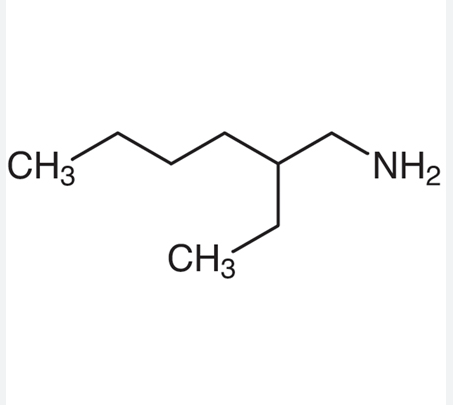
2-Ethylhexylamine Properties
| Melting point | -76 °C |
|---|---|
| Boiling point | 169 °C(lit.) |
| Density | 0.789 g/mL at 25 °C(lit.) |
| vapor pressure | 1.2 mm Hg ( 20 °C) |
| refractive index | n20/D 1.431(lit.) |
| Flash point | 126 °F |
| storage temp. | Flammables area |
| solubility | 1.6g/l |
| pka | 10.75±0.10(Predicted) |
| form | Liquid |
| color | Clear colorless |
| explosive limit | 1.6-7.7%(V) |
| Water Solubility | 2.5 g/L (20 ºC) |
| Sensitive | Air Sensitive |
| BRN | 1209249 |
| Stability | Stable. Combustible. Incompatible with strong oxidizing agents. |
| InChI | 1S/C8H19N/c1-3-5-6-8(4-2)7-9/h8H,3-7,9H2,1-2H3 |
| InChIKey | LTHNHFOGQMKPOV-UHFFFAOYSA-N |
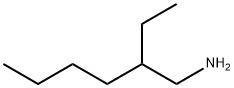
| SMILES | CCCCC(CC)CN |
| LogP | 2.82 at 20℃ |
| CAS DataBase Reference | 104-75-6(CAS DataBase Reference) |
| EWG’s Food Scores | 1 |
| FDA UNII | ER54Q9L9W3 |
| NIST Chemistry Reference | 1-Hexanamine, 2-ethyl-(104-75-6) |
| EPA Substance Registry System | 2-Ethylhexylamine (104-75-6) |
| UNSPSC Code | 12352100 |
| NACRES | NA.22 |
SAFETY
Risk and Safety Statements
| Symbol(GHS) |    GHS02,GHS05,GHS06 |
|---|---|
| Signal word | Danger |
| Hazard statements | H226-H302-H311-H314-H330 |
| Precautionary statements | P210-P280-P301+P312+P330-P303+P361+P353-P304+P340+P310-P305+P351+P338+P310 |
| PPE | Faceshields, Gloves, Goggles, type ABEK (EN14387) respirator filter |
| Hazard Codes | T,C |
| Risk Statements | 10-21/22-23-34 |
| Safety Statements | 26-36/37/39-45-16 |
| RIDADR | UN 2276 3/PG 3 |
| WGK Germany | 2 |
| RTECS | MQ5250000 |
| Autoignition Temperature | 563 °F |
| TSCA | TSCA listed |
| HazardClass | 3 |
| PackingGroup | III |
| HS Code | 29211980 |
| Storage Class | 3 – Flammable liquids |
| Hazard Classifications | Acute Tox. 2 Inhalation Acute Tox. 3 Dermal Acute Tox. 4 Oral Eye Dam. 1 Flam. Liq. 3 Skin Corr. 1B |
| Limited Quantities | 5.0 L (1.3 gallons) (liquid) |
| Excepted Quantities | Max Inner Pack (30g or 30ml) and Max Outer Pack (1Kg or 1L) |
2-Ethylhexylamine Chemical Properties,Uses,Production
Description
2-Ethylhexylamine is used as an intermediate to manufacture agricultural chemicals, rubber chemicals, pharmaceuticals, surfactants, polymerization auxiliaries, plastic additives, dyes, insecticides, flotation agents, corrosion inhibitors, paint additives, detergents, fuel additives, and lubricant additives1. Novel 2-Ethylhexylamine salt anionic monoazo dyes are very useful for dyeing solvents, printing inks or polymeric film-forming materials2.
Reference
- www.chemicalland21.com/industrialchem/organic/2-ETHYLHEXYLAMINE.htm
- Loeffler, Hermann, and R. Dyllick-Brenzinger. “2-ethylhexylamine salts of anionic monoazo dyes.” US, US 4668774 A. 1987.
Chemical Properties
colourless liquid
Chemical Properties
2-Ethylhexylamine is a corrosive liquid.
Uses
2-Ethylhexylamine is used in organic syntheses.
Uses
2-Ethylhexylamine is used to make pharmaceuticals and other chemicals. It is used as beam material and surface active agent. It also involves in synthesis of aliphatic amines.
Uses
Synthesis of detergents, rubber chemicals, oil additives, and insecticides.
General Description
A water-white liquid with a fishlike odor. Less dense than water. Flash point 140°F. Extremely irritating to skin and eyes. Vapors heavier than air. Used to make pharmaceuticals and other chemicals.
Air & Water Reactions
Flammable. Soluble in water. Sensitive to prolonged exposure to air.
Reactivity Profile
2-Ethylhexylamine reacts with oxidizing materials . Neutralizes acids in exothermic reactions to form salts plus water. May be incompatible with isocyanates, halogenated organics, peroxides, phenols (acidic), epoxides, anhydrides, and acid halides. Flammable gaseous hydrogen may be generated in combination with strong reducing agents, such as hydrides.
Hazard
Moderate fire risk. Toxic by ingestion and inhalation.
Health Hazard
INHALATION: High concentration of vapor will produce irritation of the respiratory tract and the lungs. Prolonged exposure may cause systemic effects. EYES: Contact with liquid may result in severe eye irritation. Exposure to concentrated vapor may result in corneal edema. SKIN: Contact with liquid may result in severe skin irritation, burns and possible skin absorption. INGESTION: May cause systemic poisoning.
Flammability and Explosibility
Flammable
Safety Profile
Poison by intraperitoneal route. Moderately toxic by ingestion, inhalation, and skin contact. Corrosive. A severe skin and eye irritant.Flammable liquid when exposed to heat or flame; can react with oxidizing materials. To fight fire, use alcohol foam, CO2, dry chemical. When heated to decomposition it emits toxic fumes of NOx. See also AMINES.
Toxics Screening Level
The ITSL for 2-ethylhexylamine is 0.1 μg/m3 based on an annual averaging time.
2-Ethylhexylamine Preparation Products And Raw materials
FAQ
Q1: About the after-sale service of products
A: After purchasing the products from our factory, we have A professional technical team and after-sales team to serve you and solve all your problems in the future.
Q2: Can I get some samples?
A: Yes, we can provide samples, but the customer will pay the freight.
Q3: How do I start paying?
Payment can be made by wire transfer or T/T, apple_pay, google_pay, gc_real_time_bank_transfer , etc.
Q4: How to confirm product quality before placing an order?
A: You can get free samples of some products. You just have to pay the shipping fee or arrange for the sample to be sent to us by express.
You can send us your product specifications and requirements and we will produce products according to your requirements.
Q5: What is your MOQ?
A: The minimum quantity we can order is 1kg.
But usually we can accept a smaller quantity, say 100g, at the cost of 100% sample charge.
Q6: Shipping Time?
A: We ship the parcel out in 1-2 days and offer tracking No.. Shipping time is different to different country. Please consult
| ACF Chemical Co., Ltd.
Leon phone/whatsapp:008615950692266 email:md@acfchemical.com No. 45 Pengwan Road, Qianwan Bonded Port Area, Qingdao Area, China (Shandong) |
|
| DMEA | 108-01-0 |
| Dodecyl trimethyl ammonium chloride | 112-00-5 |
| N-Hexadecyltrimethylammonium chloride | 112-02-7 |
| 1831 | 112-03-8 |
| 1631Br | 57-09-0 |
| D821 | 5538-94-3 |
| D8/1021 | 68424-95-3 |
| D1021 | 7173-51-5 |
| D1821 | 61789-80-8 |
| TEP88 | 157905-74-3 |
| 1227 C12 | 139-07-1 |
| DMPT(N,N-Dimethyl-p-toluidine) | 99-97-8 |
| NDPT(N,N-dihydroxyethyl-p-toluidine) | 3077-12-1. |
| DMA(N,N-dimethylaniline) | 121-69-7 |
| N,N-Diethylaniline | 91-66-7 |
| MT(M-Toluidine) | 108-44-1 |
| PT(P-Toluidine) | 106-49-0 |
| O-Toluidine OT | 95-53-4 |
| Dimethyl(octyl)amine | 7378-99-6/1120-24-7 |
| C16-18-alkyldimethyl Octadecyl/Hexadecyl dimethylamines | 68390-97-6 |
| Octadecyl/behenyl dimethylamines | 124046-42-0 |
| N,N-dimethyldocosylamine | 21542-96-1 |
| N-Methyldioctylamine | 4455-26-9 |
| Di(octyl/decyl) methylamines | 308062-61-5 |
| Didecyl methylamine | 7396-58-9 |
| N-methyldidodecylamine | 2915-90-4 |
| Dipalmitamine | 16724-61-1 |
| Trioctylamine | 1116-76-3 |
| Trioctylamine | 68814-95-9 |
| N-3-Laurylamidopropyl dimethylamine | 3179-80-4 |
| N-3-(Hydrogenated cocoamido)propyl dimethylamines | 288095-05-6 |
| N-3-Oleylamidopropyl dimethylamine | 109-28-4 |
| N-3-Erucylamidopropyl dimethylamine | 60270-33-9 |
| N-Oleyl 1,3-propanediamine | 7173-62-8 |
| Bis(aminopropyl)laurylamine | 2372-82-9 |
| N-tallow alkyltripropylenetetra | 68911-79-5 |
| 3-(isodecyloxy)propylamine | 30113-45-2 |
| N-[3-(isodecyloxy)propyl]propane-1,3-diamine | 72162-46-0 |
| 2-(Methylamino)ethanol | 109-83-1 |
| N-Methyldiethanolamine | 105-59-9 |
| 3-Methoxy propyl amine | 5332-73-0 |
| N,N-dimethylcyclohexylamine | 98-94-2 |
| 1,3,5-Tris[3-(dimethylamino)propyl]hexahydro-1,3,5-triazine | 15875-13-5 |
| N,N,N’-trimethylamino-N’-ethylethanolamine | 2212-32-0 |
| N,N-Dimethylethanolamine | 108-01-1 |
| Acetone | |
| Acrylic acid | |
| Adipic acid | |
| Alpha-Methylstyrene (AMS) | |
| Benzoic Acid | |
| Bisphenol A | |
| Butyl Acrylat (BA) | |
| Butyl acetate (Butac) | |
| Butyl diglycol (BDG) | |
| Butyl glycol | |
| Para-tertiary butyl benzoic acid (PTBBA) | |
| n-Butanol | |
| n-Butyl methacrylate (n-BUMA) | |
| para-tert. Butylphenol (PTBP) | |


