
product description
Basic Info.
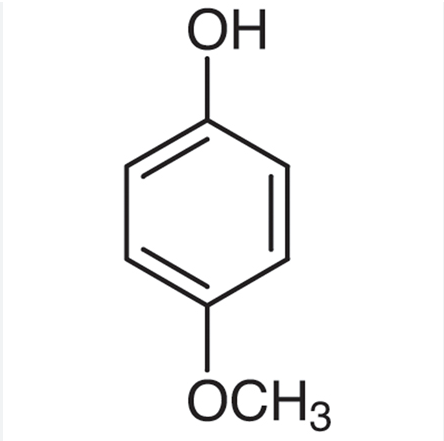
4-Methoxyphenol Properties
| Melting point | 56 °C |
|---|---|
| Boiling point | 243 °C(lit.) |
| Density | 1,55 g/cm3 |
| vapor density | 4.3 (vs air) |
| vapor pressure | <0.01 mm Hg ( 20 °C) |
| refractive index | 1.5286 (estimate) |
| Flash point | >230 °F |
| storage temp. | Store below +30°C. |
| solubility | Soluble in acetone, ethyl acetate, ethanol, ether, benzene and carbon tetrachloride. |
| pka | 10.21(at 25℃) |
| form | Liquid |
| color | Clear colorless to pale yellow |
| PH | 5.1 (30g/l, H2O, 20℃) |
| Odor | at 1.00%indipropylene glycol. phenolic |
| Odor Threshold | 0.0027ppm |
| Water Solubility | 40 g/L (25 ºC) |
| BRN | 507924 |
| Exposure limits | ACGIH: TWA 5 mg/m3 NIOSH: TWA 5 mg/m3 |
| Stability | Stable. Combustible. Incompatible with halogens, oxidizing agents. |
| Cosmetics Ingredients Functions | REDUCING ANTIOXIDANT |
| InChI | 1S/C7H8O2/c1-9-7-4-2-6(8)3-5-7/h2-5,8H,1H3 |
| InChIKey | NWVVVBRKAWDGAB-UHFFFAOYSA-N |
| SMILES | COc1ccc(O)cc1 |
| LogP | 1.3 at 20℃ |
| FDA 21 CFR | 177.1010 |
| Indirect Additives used in Food Contact Substances | 4-METHOXYPHENOL |
| CAS DataBase Reference | 150-76-5(CAS DataBase Reference) |
| EWG’s Food Scores | 4-7 |
| FDA UNII | 6HT8U7K3AM |
| ATC code | D11AX06 |
| NIST Chemistry Reference | Mequinol(150-76-5) |
| EPA Substance Registry System | p-Methoxyphenol (150-76-5) |
| UNSPSC Code | 85151701 |
| NACRES | NA.24 |
SAFETY
Risk and Safety Statements
| Symbol(GHS) |  GHS07 |
|||||||||
|---|---|---|---|---|---|---|---|---|---|---|
| Signal word | Warning | |||||||||
| Hazard statements | H302-H317-H319-H412 | |||||||||
| Precautionary statements | P261-P273-P280-P301+P312-P302+P352-P305+P351+P338 | |||||||||
| PPE | dust mask type N95 (US), Eyeshields, Faceshields, Gloves | |||||||||
| Hazard Codes | Xn | |||||||||
| Risk Statements | 22-36-43 | |||||||||
| Safety Statements | 24/25-26-37/39-46 | |||||||||
| OEB | B | |||||||||
| OEL | TWA: 5 mg/m3 | |||||||||
| WGK Germany | 1 | |||||||||
| RTECS | SL7700000 | |||||||||
| Autoignition Temperature | 789 °F | |||||||||
| TSCA | TSCA listed | |||||||||
| HS Code | 29095090 | |||||||||
| Storage Class | 11 – Combustible Solids | |||||||||
| Hazard Classifications | Acute Tox. 4 Oral Aquatic Chronic 3 Eye Irrit. 2 Skin Sens. 1 |
|||||||||
| Hazardous Substances Data | 150-76-5(Hazardous Substances Data) | |||||||||
| Toxicity | LD50 orally in Rabbit: 1600 mg/kg | |||||||||
| NFPA 704 |
|
4-Methoxyphenol Chemical Properties,Uses,Production
Description
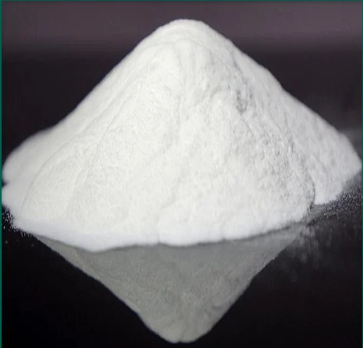
4-Methoxyphenol is a colorless to white, waxy solid with an odor of caramel and phenol. A combustible solid. Molecular weight= 124.15;Boiling point=243℃; Freezing/Melting point=5253℃; Flash point=132℃. Hazard Identification (based on NFPA-704 M Rating System): Health 2, Flammability 1, Reactivity 0. Slightly soluble in water.
Chemical Properties
4-Methoxyphenol is a colorless to white, waxy solid with an odor of caramel and phenol. It is a combustible solid. It is used as an inhibitor for acrylic monomers and as a stabilizer for chlorinated hydrocarbons, ethyl cellulose, and UV inhibitors.
Uses
4-Methoxyphenol is an active ingredient and used in dermatology. It is employed as a pharmaceutical drug in skin depigmentation. It is used as polymerization inhibitors. For example, in the radical polymerization of acryaltes and styrene monomers. It is also used as an intermediate in the preparationagrochemicals, liquid crystals. It acts as a stabilizer for the formulation of inks, toners and adhesives. It is mainly used as an additive for textile and leather industries.
Indications
Mequinol (4-hydroxyanisole) is a substrate of the enzyme tyrosinase and acts as a competitive inhibitor of melanogenesis.
Synthesis
4-Methoxyphenol was synthesised according to Oxidation with H2O2 and a Diselenide catalyst.
p-Anisaldehyde (50 mmol) is dissolved in CH2Cl2 (100mL) and (o-NO2PhSe)2 (2 mmol) and 30% H2O2 (13mL, 128 mmol) are added. The mixture is stirred magnetically at room temperature (water bath) for 30 minutes. Insoluble catalyst is removed by filtration and washed with CH2Cl2 (20mL) and water (20mL). It can be reused after drying. To the filtrate and washings, water (100mL) is added, and the layers are separated after shaking. The organic layer is washed subsequently with 10% NaHSO3 (100mL), 10% Na2CO3 (100mL), water (100mL) and dried over Na2SO4. 4-methoxyphenol is obtained by alkaline hydrolysis of the residue. Yield: 93%.
Definition
ChEBI: P-methoxyphenol is a member of phenols and a member of methoxybenzenes. It has a role as a metabolite.
Reactions
4-methoxyphenol(4-MP) may be used in the synthesis of butylated hydroxy anisoles via alkylation with methyl tert-butyl ether over a non-zeolitic solid acidic catalyst. This process is eco-friendly when compared to the Friedel-Crafts alkylation reaction. 4-MP may also react with aqueous nitrous acid to form 2-nitro-4-methoxyphenol and benzoquinone in varying ratios depending on the reaction conditions. 4-MP can be used as a building block in designing β-cyclodextrin 4-methoxyphenol conjugates that can be potential ligands for drug complexation.
General Description
Pink crystals or white waxy solid.
Air & Water Reactions
Sensitive to moisture. Water soluble.
Reactivity Profile
4-Methoxyphenol can react with oxidizing materials.
Hazard
Eye irritant and skin damage.
Health Hazard
4-Methoxyphenol is expected to cause liver and renal toxicity with narcosis, but only at high levels of exposure.
Fire Hazard
Combustible
Flammability and Explosibility
Non flammable
Safety Profile
Poison by intraperitoneal route. A skin irritant. When heated to decomposition it emits acrid smoke and fumes. See also ETHERS.
Potential Exposure
Mutagen, Primary Irritant. This compound is used in the manufacture of antioxidants, pharmaceuticals, plasticizers, and dyestuffs. It is used as a stabilizer and UV inhibitor in various polymers.
First aid
If this chemical gets into the eyes, remove any contact lenses at once and irrigate immediately for at least 15 min, occasionally lifting upper and lower lids. Seek medical attention immediately. If this chemical contacts the skin, remove contaminated clothing and wash immediately with soap and water. Seek medical attention immediately. If this chemical has been inhaled, remove from exposure, begin rescue breathing (using universal precautions, including resuscitation mask) if breathing has stopped and CPR if heart action has stopped. Transfer promptly to a medical facility. When this chemical has been swallowed, get medical attention. Give large quantities of water and induce vomiting. Do not make an unconscious person vomit.
storage
Protect containers from physical damage. Store in tightly closed containers in a cool, well-ventilated area. Sources of ignition, such as smoking and open flames, are prohibited where 4-methoxyphenol is used, handled, or stored in a manner that could create a potential fire or explosion hazard.
Shipping
UN3335 Aviation regulated solid, n.o.s., Hazard class: 9; Labels: 9-Miscellaneous hazardous material, Technical Name Required.
Purification Methods
Crystallise 4-methoxyphenol from *benzene, pet ether or H2O, and dry it under vacuum over P2O5 at room temperature. Sublime it in vacuo. [Wolfenden et al. J Am Chem Soc 109 463 1987, Beilstein 6 IV 5717.]
Incompatibilities
Strong oxidizers, strong bases, acid chlorides, acid anhydrides. Under certain conditions, a dust cloud can probably explode if ignited by a spark or flame.
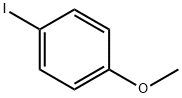
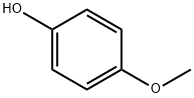
4-Methoxyphenol Preparation Products And Raw materials
FAQ
Q1: About the after-sale service of products
A: After purchasing the products from our factory, we have A professional technical team and after-sales team to serve you and solve all your problems in the future.
Q2: Can I get some samples?
A: Yes, we can provide samples, but the customer will pay the freight.
Q3: How do I start paying?
Payment can be made by wire transfer or T/T, apple_pay, google_pay, gc_real_time_bank_transfer , etc.
Q4: How to confirm product quality before placing an order?
A: You can get free samples of some products. You just have to pay the shipping fee or arrange for the sample to be sent to us by express.
You can send us your product specifications and requirements and we will produce products according to your requirements.
Q5: What is your MOQ?
A: The minimum quantity we can order is 1kg.
But usually we can accept a smaller quantity, say 100g, at the cost of 100% sample charge.
Q6: Shipping Time?
A: We ship the parcel out in 1-2 days and offer tracking No.. Shipping time is different to different country. Please consult
| ACF Chemical Co., Ltd.
Leon phone/whatsapp:008615950692266 email:md@acfchemical.com No. 45 Pengwan Road, Qianwan Bonded Port Area, Qingdao Area, China (Shandong) |
|
| DMEA | 108-01-0 |
| Dodecyl trimethyl ammonium chloride | 112-00-5 |
| N-Hexadecyltrimethylammonium chloride | 112-02-7 |
| 1831 | 112-03-8 |
| 1631Br | 57-09-0 |
| D821 | 5538-94-3 |
| D8/1021 | 68424-95-3 |
| D1021 | 7173-51-5 |
| D1821 | 61789-80-8 |
| TEP88 | 157905-74-3 |
| 1227 C12 | 139-07-1 |
| DMPT(N,N-Dimethyl-p-toluidine) | 99-97-8 |
| NDPT(N,N-dihydroxyethyl-p-toluidine) | 3077-12-1. |
| DMA(N,N-dimethylaniline) | 121-69-7 |
| N,N-Diethylaniline | 91-66-7 |
| MT(M-Toluidine) | 108-44-1 |
| PT(P-Toluidine) | 106-49-0 |
| O-Toluidine OT | 95-53-4 |
| Dimethyl(octyl)amine | 7378-99-6/1120-24-7 |
| C16-18-alkyldimethyl Octadecyl/Hexadecyl dimethylamines | 68390-97-6 |
| Octadecyl/behenyl dimethylamines | 124046-42-0 |
| N,N-dimethyldocosylamine | 21542-96-1 |
| N-Methyldioctylamine | 4455-26-9 |
| Di(octyl/decyl) methylamines | 308062-61-5 |
| Didecyl methylamine | 7396-58-9 |
| N-methyldidodecylamine | 2915-90-4 |
| Dipalmitamine | 16724-61-1 |
| Trioctylamine | 1116-76-3 |
| Trioctylamine | 68814-95-9 |
| N-3-Laurylamidopropyl dimethylamine | 3179-80-4 |
| N-3-(Hydrogenated cocoamido)propyl dimethylamines | 288095-05-6 |
| N-3-Oleylamidopropyl dimethylamine | 109-28-4 |
| N-3-Erucylamidopropyl dimethylamine | 60270-33-9 |
| N-Oleyl 1,3-propanediamine | 7173-62-8 |
| Bis(aminopropyl)laurylamine | 2372-82-9 |
| N-tallow alkyltripropylenetetra | 68911-79-5 |
| 3-(isodecyloxy)propylamine | 30113-45-2 |
| N-[3-(isodecyloxy)propyl]propane-1,3-diamine | 72162-46-0 |
| 2-(Methylamino)ethanol | 109-83-1 |
| N-Methyldiethanolamine | 105-59-9 |
| 3-Methoxy propyl amine | 5332-73-0 |
| N,N-dimethylcyclohexylamine | 98-94-2 |
| 1,3,5-Tris[3-(dimethylamino)propyl]hexahydro-1,3,5-triazine | 15875-13-5 |
| N,N,N’-trimethylamino-N’-ethylethanolamine | 2212-32-0 |
| N,N-Dimethylethanolamine | 108-01-1 |
| Acetone | |
| Acrylic acid | |
| Adipic acid | |
| Alpha-Methylstyrene (AMS) | |
| Benzoic Acid | |
| Bisphenol A | |
| Butyl Acrylat (BA) | |
| Butyl acetate (Butac) | |
| Butyl diglycol (BDG) | |
| Butyl glycol | |
| Para-tertiary butyl benzoic acid (PTBBA) | |
| n-Butanol | |
| n-Butyl methacrylate (n-BUMA) | |
| para-tert. Butylphenol (PTBP) | |


