
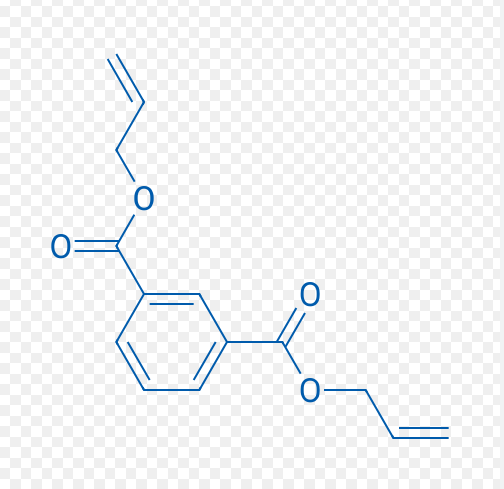
DIALLYL ISOPHTHALATE CAS Number: 1087-21-4
| Product | DIALLYL ISOPHTHALATE |
| CAS | 1087-21-4 |
| MF | C14H14O4 |
| Formula | 1,3-Benzenedicarboxylicacid,di-2-propenylester;1,3-Benzenedicarboxylicacid,di-2-propenylester;dappu100;Di-2-PropenylisoChemicalbookphthalate;di-2-propenylisophthalate;Diallylm-phthalate;Isophthalicacid,di-(2-propenyl)ester;ISOPHTHALICACIDDIALLYLESTER |
product description
Basic Info.
DIALLYL ISOPHTHALATE Properties
| Melting point | -3℃ |
|---|---|
| Boiling point | 176-177°C 5mm |
| Density | 1.13 |
| vapor pressure | 0.155Pa at 25℃ |
| refractive index | 1.5230-1.5270 |
| Flash point | 163 °C |
| storage temp. | 0-10°C |
| Specific Gravity | 1.125 (20/4℃) |
| Water Solubility | 33.8mg/L at 25℃ |
| LogP | 3.36 at 25℃ |
| CAS DataBase Reference | 1087-21-4(CAS DataBase Reference) |
| EWG’s Food Scores | 1 |
| EPA Substance Registry System | 1,3-Benzenedicarboxylic acid, di-2-propenyl ester (1087-21-4) |
SAFETY
Risk and Safety Statements
| Symbol(GHS) |  GHS07 |
|---|---|
| Signal word | Warning |
| Hazard statements | H302-H315-H319 |
| Precautionary statements | P264-P270-P280-P301+P312+P330-P302+P352+P332+P313+P362+P364-P305+P351+P338+P337+P313-P501 |
| Risk Statements | 36/37/38 |
| Safety Statements | 26-36/37/39 |
| RTECS | CZ4230000 |
| TSCA | TSCA listed |
| HS Code | 29155090 |
| Toxicity | mammal (species unspecified),LD50,oral,1700mg/kg (1700mg/kg),Gigiena i Sanitariya. For English translation, see HYSAAV. Vol. 39(4), Pg. 86, 1974. |
DIALLYL ISOPHTHALATE Chemical Properties,Uses,Production
Uses
Diallyl isophthalate (DAIP) has the advantage over the ortho isomer that it polymerizes faster and gives polymers of better heat resistance. The DAIP prepolymer is less stable than the diallyl phthalate prepolymer. Cured moldings from DAIP monomer-prepolymer compositions can be better processed than cured diallyl phthalate moldings because of their greater fluidity. Compositions containing DAIP prepolymers can be used for the production of hard, translucent, abrasive-resistant, and laser-trimmable coatings.
Preparation
Diallyl isophthalate (DAIP) is prepared by esterification of isophthalic acid with allyl alcohol:
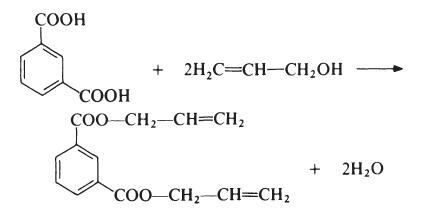
The polymers of diallyl isophthalate are very similar in preparation, properties and application to the polymers of diallyl phthalate described above. Mouldings based on diallyl isophthalate are more expensive but have enhanced thermal stability (withstanding up to about 220??C for long periods) and resistance to organic solvents.
Flammability and Explosibility
Not classified
DIALLYL ISOPHTHALATE Preparation Products And Raw materials
FAQ
Q1: About the after-sale service of products
A: After purchasing the products from our factory, we have A professional technical team and after-sales team to serve you and solve all your problems in the future.
Q2: Can I get some samples?
A: Yes, we can provide samples, but the customer will pay the freight.
Q3: How do I start paying?
Payment can be made by wire transfer or T/T, apple_pay, google_pay, gc_real_time_bank_transfer , etc.
Q4: How to confirm product quality before placing an order?
A: You can get free samples of some products. You just have to pay the shipping fee or arrange for the sample to be sent to us by express.
You can send us your product specifications and requirements and we will produce products according to your requirements.
Q5: What is your MOQ?
A: The minimum quantity we can order is 1kg.
But usually we can accept a smaller quantity, say 100g, at the cost of 100% sample charge.
Q6: Shipping Time?
A: We ship the parcel out in 1-2 days and offer tracking No.. Shipping time is different to different country. Please consult
| ACF Chemical Co., Ltd.
Leon phone/whatsapp:008615950692266 email:md@acfchemical.com No. 45 Pengwan Road, Qianwan Bonded Port Area, Qingdao Area, China (Shandong) |
|
| DMEA | 108-01-0 |
| Dodecyl trimethyl ammonium chloride | 112-00-5 |
| N-Hexadecyltrimethylammonium chloride | 112-02-7 |
| 1831 | 112-03-8 |
| 1631Br | 57-09-0 |
| D821 | 5538-94-3 |
| D8/1021 | 68424-95-3 |
| D1021 | 7173-51-5 |
| D1821 | 61789-80-8 |
| TEP88 | 157905-74-3 |
| 1227 C12 | 139-07-1 |
| DMPT(N,N-Dimethyl-p-toluidine) | 99-97-8 |
| NDPT(N,N-dihydroxyethyl-p-toluidine) | 3077-12-1. |
| DMA(N,N-dimethylaniline) | 121-69-7 |
| N,N-Diethylaniline | 91-66-7 |
| MT(M-Toluidine) | 108-44-1 |
| PT(P-Toluidine) | 106-49-0 |
| O-Toluidine OT | 95-53-4 |
| Dimethyl(octyl)amine | 7378-99-6/1120-24-7 |
| C16-18-alkyldimethyl Octadecyl/Hexadecyl dimethylamines | 68390-97-6 |
| Octadecyl/behenyl dimethylamines | 124046-42-0 |
| N,N-dimethyldocosylamine | 21542-96-1 |
| N-Methyldioctylamine | 4455-26-9 |
| Di(octyl/decyl) methylamines | 308062-61-5 |
| Didecyl methylamine | 7396-58-9 |
| N-methyldidodecylamine | 2915-90-4 |
| Dipalmitamine | 16724-61-1 |
| Trioctylamine | 1116-76-3 |
| Trioctylamine | 68814-95-9 |
| N-3-Laurylamidopropyl dimethylamine | 3179-80-4 |
| N-3-(Hydrogenated cocoamido)propyl dimethylamines | 288095-05-6 |
| N-3-Oleylamidopropyl dimethylamine | 109-28-4 |
| N-3-Erucylamidopropyl dimethylamine | 60270-33-9 |
| N-Oleyl 1,3-propanediamine | 7173-62-8 |
| Bis(aminopropyl)laurylamine | 2372-82-9 |
| N-tallow alkyltripropylenetetra | 68911-79-5 |
| 3-(isodecyloxy)propylamine | 30113-45-2 |
| N-[3-(isodecyloxy)propyl]propane-1,3-diamine | 72162-46-0 |
| 2-(Methylamino)ethanol | 109-83-1 |
| N-Methyldiethanolamine | 105-59-9 |
| 3-Methoxy propyl amine | 5332-73-0 |
| N,N-dimethylcyclohexylamine | 98-94-2 |
| 1,3,5-Tris[3-(dimethylamino)propyl]hexahydro-1,3,5-triazine | 15875-13-5 |
| N,N,N’-trimethylamino-N’-ethylethanolamine | 2212-32-0 |
| N,N-Dimethylethanolamine | 108-01-1 |
| Acetone | |
| Acrylic acid | |
| Adipic acid | |
| Alpha-Methylstyrene (AMS) | |
| Benzoic Acid | |
| Bisphenol A | |
| Butyl Acrylat (BA) | |
| Butyl acetate (Butac) | |
| Butyl diglycol (BDG) | |
| Butyl glycol | |
| Para-tertiary butyl benzoic acid (PTBBA) | |
| n-Butanol | |
| n-Butyl methacrylate (n-BUMA) | |
| para-tert. Butylphenol (PTBP) | |


