
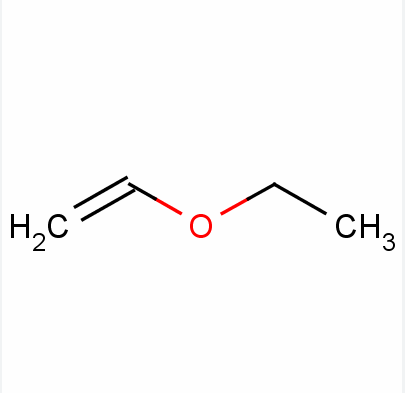
Poly(ethyl vinyl ether) CAS Number: 25104-37-4
| Product | Poly(ethyl vinyl ether) |
| CAS | 25104-37-4 |
| MF | C4H8O |
| Formula | VinylEthylEtherResin(LowM.Wt.);VinylethylethereesinHighMWt;Poly(vinylethylether),lowmolecularweight;
5-ethyl-5-(6-oxo-1-cyclohexen-1-ylChemicalbook)-barbituricacid;POLY(VINYLETHYLETHER);POLY(ETHYLVINYLETHER);VINYLETHYLETHERRESIN;5-(3or6-oxo-1-cyclohexen-1-yl)-5-ethylbarbituricacid |
product description
Basic Info.
Poly(ethyl vinyl ether) Properties
| Density | 0.968 g/mL at 25 °C (lit.) |
|---|---|
| Tg | -60 |
| vapor pressure | 22.5 mm Hg ( 20 °C) |
| refractive index | n20/D 1.454(lit.) |
| Flash point | 140 |
| form | Viscous liquid |
| Viscosity | 0.3 (20C)(Reduced viscosity) |
| InChI | InChI=1S/C4H8O/c1-3-5-4-2/h3H,1,4H2,2H3 |
| InChIKey | FJKIXWOMBXYWOQ-UHFFFAOYSA-N |
| SMILES | O(C=C)CC |
| Indirect Additives used in Food Contact Substances | POLY(ETHYL VINYL ETHER) |
| CAS DataBase Reference | 25104-37-4 |
| EPA Substance Registry System | Poly(vinyl ethyl ether) (25104-37-4) |
| UNSPSC Code | 12162002 |
| NACRES | NA.23 |
SAFETY
Risk and Safety Statements

Poly(ethyl vinyl ether) Chemical Properties,Uses,Production
Chemical Properties
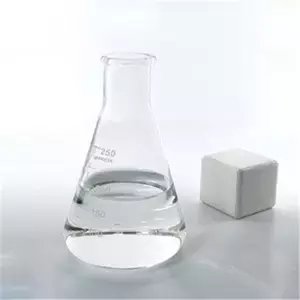
Poly(ethyl vinyl ether) is a opaque amber viscous liquid, It is a hydrophobic material that is insoluble in water or other polar solvents.
Uses
Poly(ethyl vinyl ether) can used as a plasticiser for cellulose nitrate and cellulose resin lacquers, as a base for pressure-sensitive adhesives in films and tapes, especially in surgical applications. Also used for non-irritating surgical casts requiring moisture permeability and to impart dry-film flexibility and increased viscosity of photochemical resist-coating compositions.
Preparation
To a flask containing 200 gm of benzene is added 1.0 gm of aluminum chloride. The mixture is stirred vigorously to suspend the catalyst and then the gradual addition of 200 gm (2.78 moles) of vinyl ether is begun. The reaction is exothermic, and when the temperature rises to 60°-80°C the addition is slowed so that only 1-2 gm of vinyl ethyl ether is added at one time. Polymerization is detected by the onset of turbidity and a slight brown color. When the brown color disappears, the next increment of vinyl ethyl ether is added. After the complete addition the reaction mixture is heated to 80°C. The benzene and volatiles are steam-distilled off, and the residue amounts to about 144 gm (72%) of a yellow balsamlike product.
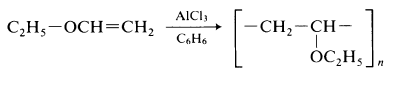
Preparation of Poly(vinyl ethyl ether) Using Aluminum Chloride Catalyst
Hazard
Moderately toxic.
Safety Profile
Moderately toxic by intraperitoneal route. When heated to decomposition it emits acrid smoke and irritating vapors.
Solubility in organics
alcohols, aliphatic, aromatic and chlorinated hydrocarbons, esters, ketones
Poly(ethyl vinyl ether) Preparation Products And Raw materials
FAQ
Q1: About the after-sale service of products
A: After purchasing the products from our factory, we have A professional technical team and after-sales team to serve you and solve all your problems in the future.
Q2: Can I get some samples?
A: Yes, we can provide samples, but the customer will pay the freight.
Q3: How do I start paying?
Payment can be made by wire transfer or T/T, apple_pay, google_pay, gc_real_time_bank_transfer , etc.
Q4: How to confirm product quality before placing an order?
A: You can get free samples of some products. You just have to pay the shipping fee or arrange for the sample to be sent to us by express.
You can send us your product specifications and requirements and we will produce products according to your requirements.
Q5: What is your MOQ?
A: The minimum quantity we can order is 1kg.
But usually we can accept a smaller quantity, say 100g, at the cost of 100% sample charge.
Q6: Shipping Time?
A: We ship the parcel out in 1-2 days and offer tracking No.. Shipping time is different to different country. Please consult
| ACF Chemical Co., Ltd.
Leon phone/whatsapp:008615950692266 email:md@acfchemical.com No. 45 Pengwan Road, Qianwan Bonded Port Area, Qingdao Area, China (Shandong) |
|
| DMEA | 108-01-0 |
| Dodecyl trimethyl ammonium chloride | 112-00-5 |
| N-Hexadecyltrimethylammonium chloride | 112-02-7 |
| 1831 | 112-03-8 |
| 1631Br | 57-09-0 |
| D821 | 5538-94-3 |
| D8/1021 | 68424-95-3 |
| D1021 | 7173-51-5 |
| D1821 | 61789-80-8 |
| TEP88 | 157905-74-3 |
| 1227 C12 | 139-07-1 |
| DMPT(N,N-Dimethyl-p-toluidine) | 99-97-8 |
| NDPT(N,N-dihydroxyethyl-p-toluidine) | 3077-12-1. |
| DMA(N,N-dimethylaniline) | 121-69-7 |
| N,N-Diethylaniline | 91-66-7 |
| MT(M-Toluidine) | 108-44-1 |
| PT(P-Toluidine) | 106-49-0 |
| O-Toluidine OT | 95-53-4 |
| Dimethyl(octyl)amine | 7378-99-6/1120-24-7 |
| C16-18-alkyldimethyl Octadecyl/Hexadecyl dimethylamines | 68390-97-6 |
| Octadecyl/behenyl dimethylamines | 124046-42-0 |
| N,N-dimethyldocosylamine | 21542-96-1 |
| N-Methyldioctylamine | 4455-26-9 |
| Di(octyl/decyl) methylamines | 308062-61-5 |
| Didecyl methylamine | 7396-58-9 |
| N-methyldidodecylamine | 2915-90-4 |
| Dipalmitamine | 16724-61-1 |
| Trioctylamine | 1116-76-3 |
| Trioctylamine | 68814-95-9 |
| N-3-Laurylamidopropyl dimethylamine | 3179-80-4 |
| N-3-(Hydrogenated cocoamido)propyl dimethylamines | 288095-05-6 |
| N-3-Oleylamidopropyl dimethylamine | 109-28-4 |
| N-3-Erucylamidopropyl dimethylamine | 60270-33-9 |
| N-Oleyl 1,3-propanediamine | 7173-62-8 |
| Bis(aminopropyl)laurylamine | 2372-82-9 |
| N-tallow alkyltripropylenetetra | 68911-79-5 |
| 3-(isodecyloxy)propylamine | 30113-45-2 |
| N-[3-(isodecyloxy)propyl]propane-1,3-diamine | 72162-46-0 |
| 2-(Methylamino)ethanol | 109-83-1 |
| N-Methyldiethanolamine | 105-59-9 |
| 3-Methoxy propyl amine | 5332-73-0 |
| N,N-dimethylcyclohexylamine | 98-94-2 |
| 1,3,5-Tris[3-(dimethylamino)propyl]hexahydro-1,3,5-triazine | 15875-13-5 |
| N,N,N’-trimethylamino-N’-ethylethanolamine | 2212-32-0 |
| N,N-Dimethylethanolamine | 108-01-1 |
| Acetone | |
| Acrylic acid | |
| Adipic acid | |
| Alpha-Methylstyrene (AMS) | |
| Benzoic Acid | |
| Bisphenol A | |
| Butyl Acrylat (BA) | |
| Butyl acetate (Butac) | |
| Butyl diglycol (BDG) | |
| Butyl glycol | |
| Para-tertiary butyl benzoic acid (PTBBA) | |
| n-Butanol | |
| n-Butyl methacrylate (n-BUMA) | |
| para-tert. Butylphenol (PTBP) | |


