
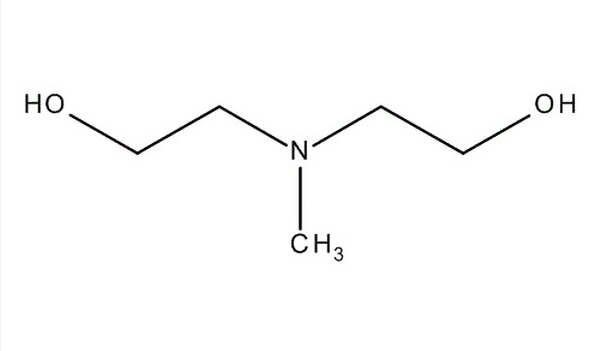
N-Methyldiethanolamine CAS Number: 105-59-9
| Product | N-Methyldiethanolamine |
| CAS | 105-59-9 |
| MF | C5H13NO2 |
| Formula | N,N-BIS(2-HYDROXYETHYL)METHYLAMINE;N-METHYL-2,2′-IMINODIETHANOL;N-METHYL-2,2-IMINOBIS(ETHANOL);N-METHYLDIETHChemicalbookANOLAMINE;N-METHYL-N-(2-HYDROXYETHYL)-2-AMINOETHANOL;METHYLDIETHANOLAMINE;MDEA;BIS(2-HYDROXYETHYL)METHYLAMINE |
product description
- Basic Info.
- CAS No. : 105-59-9
- Chemical Name: : N-Methyldiethanolamine
- Synonyms : MDEA;METHYL DIETHANOLAMINE;Methyldiethanolamin;Methyliminodiethanol;FC MDEA;usafdo-52;USAF DO-52;Mdea (diol);Diethanolmethylamine;N-Methyldiethanolami
- CBNumber: : CB3260193
- Molecular Formula: : C5H13NO2
- Molecular Weight: : 119.16
N-Methyldiethanolamine Properties
| Melting point | -21 °C |
|---|---|
| Boiling point | 246-248 °C(lit.) |
| Density | 1.038 g/mL at 25 °C(lit.) |
| vapor density | 4 (vs air) |
| vapor pressure | 0.01 mm Hg ( 20 °C) |
| refractive index | n20/D 1.469(lit.) |
| Flash point | 260 °F |
| storage temp. | Store below +30°C. |
| solubility | Chloroform (Slightly), Methanol (Slightly) |
| pka | 14.41±0.10(Predicted) |
| form | Liquid |
| color | Clear colorless to light yellow |
| Odor | Ammonical |
| PH | 11.5 (100g/l, H2O, 20℃) |
| PH Range | 11.5 at 100 g/l at 20 °C |
| Viscosity | 99.05mm2/s |
| explosive limit | 0.9-8.4%(V) |
| Water Solubility | MISCIBLE |
| BRN | 1734441 |
| Stability | Stable. Combustible. Incompatible with strong oxidizing agents. |
| Cosmetics Ingredients Functions | FILM FORMING |
| InChI | 1S/C5H13NO2/c1-6(2-4-7)3-5-8/h7-8H,2-5H2,1H3 |
| InChIKey | CRVGTESFCCXCTH-UHFFFAOYSA-N |
| SMILES | N(CCO)(CCO)C |
| LogP | -1.16 at 23℃ |
| Surface tension | 33.5 mN/m at 303.15K |
| Indirect Additives used in Food Contact Substances | N-METHYLDIETHANOLAMINE |
| CAS DataBase Reference | 105-59-9(CAS DataBase Reference) |
| FDA UNII | 3IG3K131QJ |
| NIST Chemistry Reference | Methyldiethanolamine(105-59-9) |
| EPA Substance Registry System | N-Methyldiethanolamine (105-59-9) |
| UNSPSC Code | 12352104 |
| NACRES | NA.22 |
SAFETY
Risk and Safety Statements
| Symbol(GHS) |  GHS07 |
|---|---|
| Signal word | Warning |
| Hazard statements | H319 |
| Precautionary statements | P264-P280-P305+P351+P338-P337+P313 |
| Hazard Codes | Xi |
| Risk Statements | 36 |
| Safety Statements | 24 |
| RIDADR | 2735 |
| WGK Germany | 1 |
| RTECS | KL7525000 |
| Autoignition Temperature | 770 °F |
| TSCA | TSCA listed |
| HS Code | 2922 17 00 |
| HazardClass | 8 |
| PackingGroup | II |
| Storage Class | 10 – Combustible liquids |
| Hazard Classifications | Eye Irrit. 2 |
| Hazardous Substances Data | 105-59-9(Hazardous Substances Data) |
| Toxicity | LD50 orally in Rabbit: 4680 mg/kg |
N-Methyldiethanolamine Chemical Properties,Uses,Production
Chemical Properties
N-Methyldiethanolamine (MDEA) is a colorless to yellow viscous liquid with an ammonia-like odor. It is completely soluble in water. N-Methyldiethanolamine is an alkyl alkanolamine.It combines the chemical characteristics of both amines and alcohols so that it is capable of undergoing reactions typical of both alcohols and amines: forming quaternary amine salts, soaps, and esters.
Uses
N-methyldiethanolamine is used as an intermediate in the synthesis of numerous products. Its unique chemistry has resulted in its use in diverse areas, including coatings, textile lubricants, polishes, detergents, pesticides, personal-care products, pharmaceuticals, urethane catalysts, and water-treatment chemicals. It is also used in absorption of acidic gases, catalyst for polyurethane foams, pH control agent.
Uses
N-Methyldiethanolamine is a reagent used for protection of boronic acids as N-methyl-O,O-diethanolamine esters.
Preparation
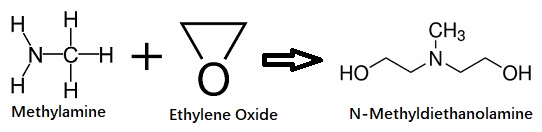
N-methyldiethanolamine is produced by the reaction between ethylene oxide and methylamine.
Synthesis Reference(s)
Journal of the American Chemical Society, 107, p. 6659, 1985 DOI: 10.1021/ja00309a039
General Description
Colorless liquid.
Air & Water Reactions
Very water soluble .
Reactivity Profile
N-Methyldiethanolamine is an aminoalcohol. Amines are chemical bases. They neutralize acids to form salts plus water. These acid-base reactions are exothermic. The amount of heat that is evolved per mole of amine in a neutralization is largely independent of the strength of the amine as a base. Amines may be incompatible with isocyanates, halogenated organics, peroxides, phenols (acidic), epoxides, anhydrides, and acid halides. Flammable gaseous hydrogen is generated by amines in combination with strong reducing agents, such as hydrides. N-Methyldiethanolamine may react with oxidizing materials.
Health Hazard
Exposure can cause irritation of eyes, nose and throat.
Fire Hazard
Special Hazards of Combustion Products: Irritating vapors and toxic gases, such as nitrogen oxides and carbon monoxide, may be formed when involved in fire.
Flammability and Explosibility
Non flammable
Environmental Fate
N-methyldiethanolamine is readily biodegradable, and its bioconcentration potential is low. Releases to the environment would not persist and would degrade rapidly. The potential for mobility in soil is very high. It is slightly toxic to aquatic organisms on an acute basis.
storage
N-methyldiethanolamine is stable under normal storage and use conditions, but elevated temperatures can cause it to decompose. Decomposition products depend upon temperature, air supply, and the presence of other materials. Avoid contact with nitrites, strong acids, and strong oxidizers. Avoid unintended contact with halogenated hydrocarbons. N-methyldiethanolamine can react with halogenated organics, resulting in temperature and/or pressure increases. It is corrosive when wet. Heating above 60°C (140°F) in the presence of aluminum can result in corrosion and generation of flammable hydrogen gas.
Toxics Screening Level
The updated initial threshold screening level (ITSL) for methyldiethanolamine is 6 μg/m3 based on an annual averaging time.
N-Methyldiethanolamine Preparation Products And Raw materials
FAQ
Q1: About the after-sale service of products
A: After purchasing the products from our factory, we have A professional technical team and after-sales team to serve you and solve all your problems in the future.
Q2: Can I get some samples?
A: Yes, we can provide samples, but the customer will pay the freight.
Q3: How do I start paying?
Payment can be made by wire transfer or T/T, apple_pay, google_pay, gc_real_time_bank_transfer , etc.
Q4: How to confirm product quality before placing an order?
A: You can get free samples of some products. You just have to pay the shipping fee or arrange for the sample to be sent to us by express.
You can send us your product specifications and requirements and we will produce products according to your requirements.
Q5: What is your MOQ?
A: The minimum quantity we can order is 1kg.
But usually we can accept a smaller quantity, say 100g, at the cost of 100% sample charge.
Q6: Shipping Time?
A: We ship the parcel out in 1-2 days and offer tracking No.. Shipping time is different to different country. Please consult
| ACF Chemical Co., Ltd.
Leon phone/whatsapp:008615950692266 email:md@acfchemical.com No. 45 Pengwan Road, Qianwan Bonded Port Area, Qingdao Area, China (Shandong) |
|
| DMEA | 108-01-0 |
| Dodecyl trimethyl ammonium chloride | 112-00-5 |
| N-Hexadecyltrimethylammonium chloride | 112-02-7 |
| 1831 | 112-03-8 |
| 1631Br | 57-09-0 |
| D821 | 5538-94-3 |
| D8/1021 | 68424-95-3 |
| D1021 | 7173-51-5 |
| D1821 | 61789-80-8 |
| TEP88 | 157905-74-3 |
| 1227 C12 | 139-07-1 |
| DMPT(N,N-Dimethyl-p-toluidine) | 99-97-8 |
| NDPT(N,N-dihydroxyethyl-p-toluidine) | 3077-12-1. |
| DMA(N,N-dimethylaniline) | 121-69-7 |
| N,N-Diethylaniline | 91-66-7 |
| MT(M-Toluidine) | 108-44-1 |
| PT(P-Toluidine) | 106-49-0 |
| O-Toluidine OT | 95-53-4 |
| Dimethyl(octyl)amine | 7378-99-6/1120-24-7 |
| C16-18-alkyldimethyl Octadecyl/Hexadecyl dimethylamines | 68390-97-6 |
| Octadecyl/behenyl dimethylamines | 124046-42-0 |
| N,N-dimethyldocosylamine | 21542-96-1 |
| N-Methyldioctylamine | 4455-26-9 |
| Di(octyl/decyl) methylamines | 308062-61-5 |
| Didecyl methylamine | 7396-58-9 |
| N-methyldidodecylamine | 2915-90-4 |
| Dipalmitamine | 16724-61-1 |
| Trioctylamine | 1116-76-3 |
| Trioctylamine | 68814-95-9 |
| N-3-Laurylamidopropyl dimethylamine | 3179-80-4 |
| N-3-(Hydrogenated cocoamido)propyl dimethylamines | 288095-05-6 |
| N-3-Oleylamidopropyl dimethylamine | 109-28-4 |
| N-3-Erucylamidopropyl dimethylamine | 60270-33-9 |
| N-Oleyl 1,3-propanediamine | 7173-62-8 |
| Bis(aminopropyl)laurylamine | 2372-82-9 |
| N-tallow alkyltripropylenetetra | 68911-79-5 |
| 3-(isodecyloxy)propylamine | 30113-45-2 |
| N-[3-(isodecyloxy)propyl]propane-1,3-diamine | 72162-46-0 |
| 2-(Methylamino)ethanol | 109-83-1 |
| N-Methyldiethanolamine | 105-59-9 |
| 3-Methoxy propyl amine | 5332-73-0 |
| N,N-dimethylcyclohexylamine | 98-94-2 |
| 1,3,5-Tris[3-(dimethylamino)propyl]hexahydro-1,3,5-triazine | 15875-13-5 |
| N,N,N’-trimethylamino-N’-ethylethanolamine | 2212-32-0 |
| N,N-Dimethylethanolamine | 108-01-1 |
| Acetone | |
| Acrylic acid | |
| Adipic acid | |
| Alpha-Methylstyrene (AMS) | |
| Benzoic Acid | |
| Bisphenol A | |
| Butyl Acrylat (BA) | |
| Butyl acetate (Butac) | |
| Butyl diglycol (BDG) | |
| Butyl glycol | |
| Para-tertiary butyl benzoic acid (PTBBA) | |
| n-Butanol | |
| n-Butyl methacrylate (n-BUMA) | |
| para-tert. Butylphenol (PTBP) | |


