What is MEHQ?
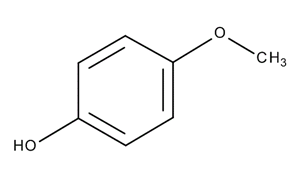
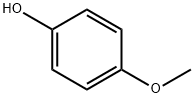
MEHQ (Monomethyl Ether of Hydroquinone) is a light-colored crystalline solid. Its chemical term is 4-Methoxyphenol. As a stabilizer, it avoids premature polymerization in acrylates, methacrylates, and other monomers. Its molecular formula is C7H8O2 and CAS number is 150-76-5.
MEHQ achieves this by neutralizing free radicals that may induce undesirable polymerization. In doing so, it safeguards sensitive chemicals when stored or transported, thus ensuring that they are stable and safe to apply.
Key Properties of MEHQ
- Appearance: White to off-white crystalline powder
- Solubility: Soluble in alcohol and ether
- Boiling Point: Approximately 243°C
- Function: Acts as an antioxidant and polymerization inhibitor
What makes MEHQ stabilizer especially valuable is its ability to maintain stability under a wide range of conditions. It works effectively even in low concentrations, making it not just efficient, but also highly economical for large-scale operations.
MEHQ Chemical Uses
The uses of MEHQ chemical span a wide array of industries due to its excellent stabilizing and antioxidant properties. Here are some of its common applications:
1. Polymer Storage
MEHQ stops acrylic acid, methacrylic acid, and their esters from turning into solid polymers during storage. If not used, the materials can harden, spoil equipment, and lead to product loss.
2. Cosmetics
MEHQ is utilized in hair dyes and skin-whitening creams in small quantities as an antioxidant. Use of MEHQ in personal care is carefully regulated.
3. Pharmaceuticals
MEHQ prevents oxidation in certain drugs. This makes the drug effective for a longer time.
4. Adhesives & Sealants
It is added to adhesives, sealants, and coatings to maintain their stability and usability in storage.
5. Chemical Production
MEHQ also prevents unnecessary reactions while producing resins and elastomers.
Benefits of Using MEHQ Stabilizer
Using MEHQ stabilizer in chemical processes offers several advantages that contribute to safer operations, cost efficiency, and product reliability. Here are its benefits:
Prevents Product Degradation
It halts premature polymerization, protecting both the material and the machinery. This ensures that monomers remain in their original state until needed. It also helps maintain the desired chemical structure during transit and storage.
Cost-Effective
Requires only small amounts to be effective, reducing material costs. Its high potency at low concentrations means less product is needed per batch. This results in better resource management and improved production economics.
Minimizes Risk
MEHQ helps prevent dangerous chemical reactions. It protects equipment from damage. It also reduces the risk of product recalls. By lowering the chance of sudden heat-related accidents, it makes chemical plants safer.
Versatile Use
It functions well under different temperatures and industrial conditions. Regardless of its use in high-temperature polymerization factories or delicate pharmaceutical laboratories, MEHQ remains stable. Such versatility qualifies it for diverse chemical applications.
Enhances Shelf Life
It helps keep monomers and resins stable for longer periods. The stability’s extension allows manufacturers to stockpile and ship materials without fear of degradation. It also ensures end-users receive consistent, high-quality raw materials.
Safety and Handling
While MEHQ is quite safe if treated properly, care must be exercised in storing and using it. Skin and eye irritation can be caused by direct contact, and dust or vapor inhalation is to be avoided. Protective gear and all precautions must be taken while handling the chemical.
Store MEHQ properly in a cool, dry area out of the reach of sunlight and incompatible chemicals such as strong oxidizing agents.
Final Thoughts
Overall, Monomethyl Ether of Hydroquinone is an invaluable stabilizer in various industries. Its efficiency, affordability, and wide use make it a popular item for inhibiting polymerization and maintaining chemical safety. From adhesives, pharmaceuticals, to the manufacture of monomers, uses of MEHQ chemicals are only increasing with rising industrial demands.
Why Choose Vinati Organics for MEHQ?
For industries that require a consistent and high-quality MEHQ stabilizer, Vinati Organics stands out as a trusted manufacturer. Our MEHQ offers exceptional efficiency even at low concentrations, making it a smart and economical choice for any industrial setup. With a focus on minimizing material waste and reducing risks, we ensure that Monomethyl Ether of Hydroquinone performs reliably under varied conditions.
Looking for premium-grade MEHQ (CAS – 150-76-5)? Contact Vinati Organics Pvt Ltd today. Our expert team will provide customized solutions, detailed specifications, and top-tier customer service to meet your business needs
Hydroquinone Monomethyl Ether – MEHQ
MEHQ flakes
MEHQ is widely used as a polymerization inhibitor in the manufacturing & storage of various monomers: Acrylics, Methacrylics and other Acrylates, Vinyl Acetate Monomers (VAM), Styrene, and unsaturated polyesters. (emulsion polymers, a.k.a. latex).
MEHQ is used as a Stabilizer for chlorinated hydrocarbons and ethyl cellulose, Liquid Detergents. It is also used in the printing ink industry as a polymerization inhibitor.
• MEHQ is manufactured using patened technology
• The process is environmentally friendly, producing only water as a by-product
• Maroon Group has partnered with the number one manufacturer in the world
| Hydroquinone Monomethyl Ether Basic information |
|
| Hydroquinone Monomethyl Ether Chemical Properties |
| Melting point |
56 °C |
| Boiling point |
243 °C(lit.) |
| density |
1,55 g/cm3 |
| vapor density |
4.3 (vs air) |
| vapor pressure |
<0.01 mm Hg ( 20 °C) |
| refractive index |
1.5286 (estimate) |
| Fp |
>230 °F |
| storage temp. |
Store below +30°C. |
| solubility |
Soluble in acetone, ethyl acetate, ethanol, ether, benzene and carbon tetrachloride. |
| pka |
10.21(at 25℃) |
| form |
Liquid |
| color |
Clear colorless to pale yellow |
| PH |
5.1 (30g/l, H2O, 20℃) |
| Odor |
at 1.00?%?in?dipropylene glycol. phenolic |
| Odor Threshold |
0.0027ppm |
| Water Solubility |
40 g/L (25 ºC) |
| BRN |
507924 |
| Exposure limits |
ACGIH: TWA 5 mg/m3
NIOSH: TWA 5 mg/m3 |
| Stability: |
Stable. Combustible. Incompatible with halogens, oxidizing agents. |
| Cosmetics Ingredients Functions |
REDUCING
ANTIOXIDANT |
| InChIKey |
NWVVVBRKAWDGAB-UHFFFAOYSA-N |
| LogP |
1.3 at 20℃ |
| CAS DataBase Reference |
150-76-5(CAS DataBase Reference) |
| NIST Chemistry Reference |
Mequinol(150-76-5) |
| EPA Substance Registry System |
p-Methoxyphenol (150-76-5) |
ACF Chemical Co., Ltd.
Athena phone/whatsapp:008613805212761
email:ceo@acfchemical.com
No. 45 Pengwan Road, Qianwan Bonded Port Area, Qingdao Area, China (Shandong)
welcome to vist our factory.
sample is free
ACF Chemical Qingdao Co., Ltd. was established in 1987. the company has over decades of experience in the production of methacrylate and acrylate series products, as well as high-efficiency polymerization inhibitors and rubber and plastic antioxidant series products. The company’s leading products are high-efficiency polymerization inhibitor series products, with an annual production capacity of 1,000 tons of tert-butylhydroquinone (TBC), 800 tons of polymerization inhibitor TH-701, 500 tons of polymerization inhibitor TH-A294, 500 tons of polymerization inhibitor TH-100BE, 500 tons of phenothiazine, and 200 tons of hydroquinone. |
| 3-Glycidoxypropyltrimethoxysilane |
2530-83-8 |
| *MTHP – Methyl Tetra Hydro Pyran |
4717-96-8 |
| HYDROQUINONE MONOMETHYL ETHER |
150-76-5 |
| MONO ISOPROPYLAMINE |
75-31-0 |
| Isopropyl Acetate (IPAC) |
108-21-4 |
| Maleic Anhydride (MA) |
108-31-6 |
| Di-propylene glycol (DPG) |
25265-71-8 |
| Trimethylolpropane (TMP) |
77-99-6 |
| Trimellitic Anhydride (TMA) |
552-30-7 |
| Ethyl Acetate (ETAC) |
141-78-6 |
| Butyl Acetate (BTAC) |
123-86-4 |
| Diphenyl carbonate;(DPC) |
102-09-0 |
| Antioxidant 24 |
26741-53-7 |
| p-Toluoylchloride |
874-60-2 |
| 2-Chlorobenzoylchloride |
609-65-4 |
| Etidronic acid (HEDP) |
2809-21-4 |
| Tetrahydrophthalic andhydride(THPA) |
85-43-8 |
| Hexahydrophthalic andhydride(HHPA) |
85-42-7 |
| Nadic Anhydride(NA) |
826-62-0 |
| HBPA |
80-04-6 |
| Succinic Anhydride |
108-30-5 |
TETREDM
Tetraethylene Glycol Dimethyl Ether |
143-24-8 |
| PROPYLENE GLYCOL MONOMETHYL ETHER ACETATE (PMA) |
108-65-6 |
| PROPYLENE GLYCOL MONOMETHYL ETHER (PM) |
107-98-2 |